How to Choose a Table Tennis Table for Home Use in India
A table tennis table is a significant investment — it needs to fit your space, survive Indian weather conditions (if going outdoors), and deliver a bounce quality that makes practice worthwhile. This guide covers every factor: sizes, materials, thickness, foldability, Indian brands, and realistic budgets so you make the right choice for your home.
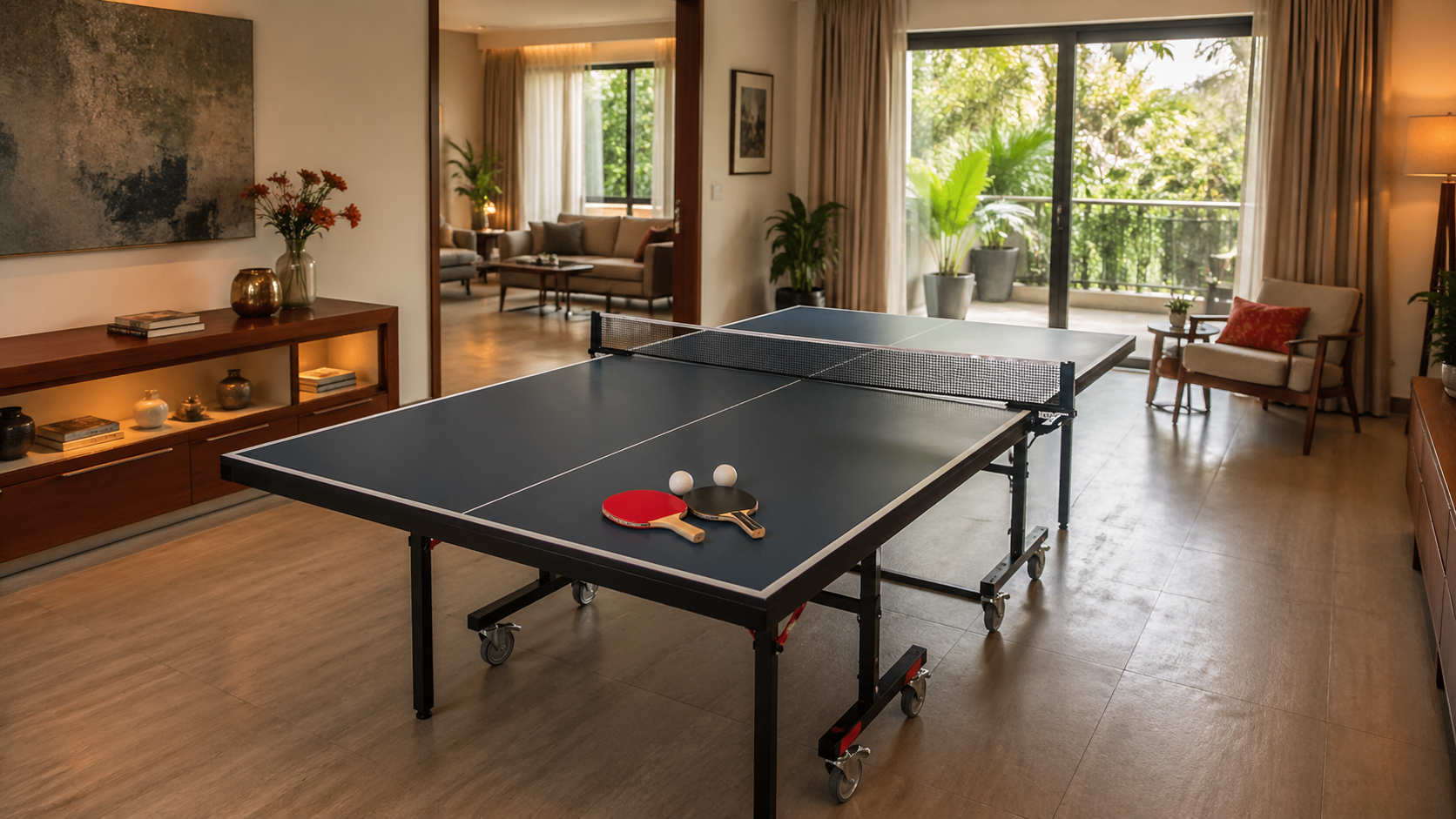
Table Sizes: Full-Size, 3/4, and Mini
Table tennis tables come in three broad size categories. Your choice depends on available space, how seriously you play, and whether the table needs to share a room with other activities.
Full-Size (9 x 5 ft / 274 x 152.5 cm)
The regulation size used in all official competitions. If you want to develop proper technique, footwork, and match-realistic play, a full-size table is non-negotiable. The table stands 76 cm (2.5 ft) high. Full-size tables require a room that is at least 17 feet long and 13 feet wide for comfortable recreational play — more if you plan to practise seriously with full stroke movement.
3/4 Size (7 x 4 ft / 213 x 122 cm)
A practical compromise for Indian apartments and smaller homes. The 3/4 size table fits in rooms where a full-size table would be too cramped. The playing experience is noticeably different from full-size — angles are compressed and footwork patterns do not translate directly — but for family recreation and basic skill development, it works well. Some schools and corporate offices in India use 3/4 size tables in common areas.
Mini Tables (5 x 3 ft and smaller)
Mini tables are toys, not training equipment. They are fun for children, dorm rooms, and office break rooms, but you cannot develop real table tennis skills on them. The bounce is inconsistent, the playing area is too small for proper strokes, and the net height relative to the table proportions is off. Buy a mini table only if entertainment value is your sole criterion.
| Size | Dimensions | Min Room Size | Suitable For | Price Range (INR) |
|---|---|---|---|---|
| Full-Size | 274 x 152.5 cm | 17 x 13 ft | Serious practice, competition | 12,000 - 2,00,000+ |
| 3/4 Size | 213 x 122 cm | 14 x 11 ft | Family recreation, small homes | 8,000 - 25,000 |
| Mini | ~150 x 80 cm | 10 x 8 ft | Casual fun, children | 3,000 - 10,000 |
Indoor vs Outdoor Tables
This distinction is critical in India, where monsoon humidity, extreme summer heat, and dust can destroy an unsuitable table within a single season.
Indoor Tables
Indoor tables use MDF (Medium Density Fibreboard) or particleboard tops. MDF provides better bounce consistency and is the standard for all competition tables. However, MDF is highly susceptible to moisture — a few hours in humid outdoor conditions can cause warping. Indoor tables must stay in climate-controlled or at least covered, dry environments. In Indian cities, this typically means an air-conditioned room, a covered hall, or at minimum a well-ventilated indoor space away from rain exposure.
Outdoor Tables
Outdoor tables use aluminium composite tops or melamine-resin coated surfaces that resist moisture, UV fading, and temperature changes. The bounce on outdoor tables is slightly different from indoor — generally a bit lower and faster — but modern outdoor tables from brands like Stag, Donic, and Cornilleau have closed this gap significantly. Outdoor tables have steel or galvanised undercarriages to prevent rust. If your plan is to put the table on a terrace, balcony, or in a garden, an outdoor table is the only viable option.
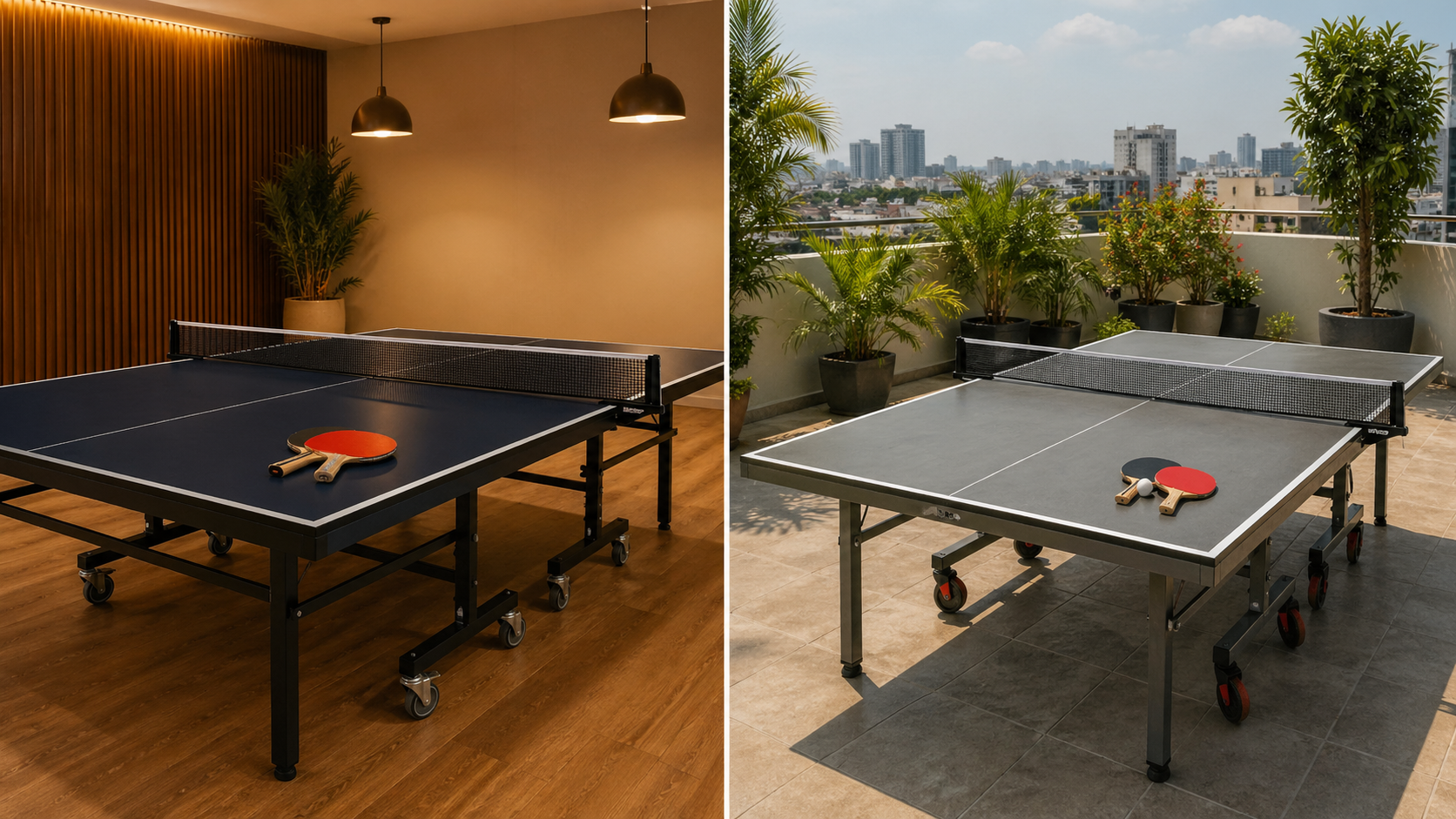
Table Top Thickness Guide
Table top thickness is the single best indicator of bounce quality. Thicker tops produce a higher, more consistent bounce. Here is what each thickness tier delivers:
| Thickness | Bounce Quality | Use Case | Price Impact |
|---|---|---|---|
| 12 mm | Low, uneven, dead spots | Budget recreation only | Cheapest |
| 15 mm | Acceptable, slightly inconsistent | Casual home play | Budget-friendly |
| 18 mm | Good, consistent across surface | Serious home practice | Mid-range |
| 19 mm | Very good, near-tournament feel | Home training, club use | Mid to high |
| 22-25 mm | Excellent, competition-standard | Tournament, professional training | Premium |
| 25+ mm | ITTF-approved, perfect bounce | ITTF-sanctioned events | Highest |
Our recommendation: 18 mm is the minimum for any player who wants to improve their game. Below 18 mm, the bounce inconsistencies will actively hinder your development. If your budget allows, 19 mm offers a noticeable step up in feel.
Foldability, Wheels, and Storage
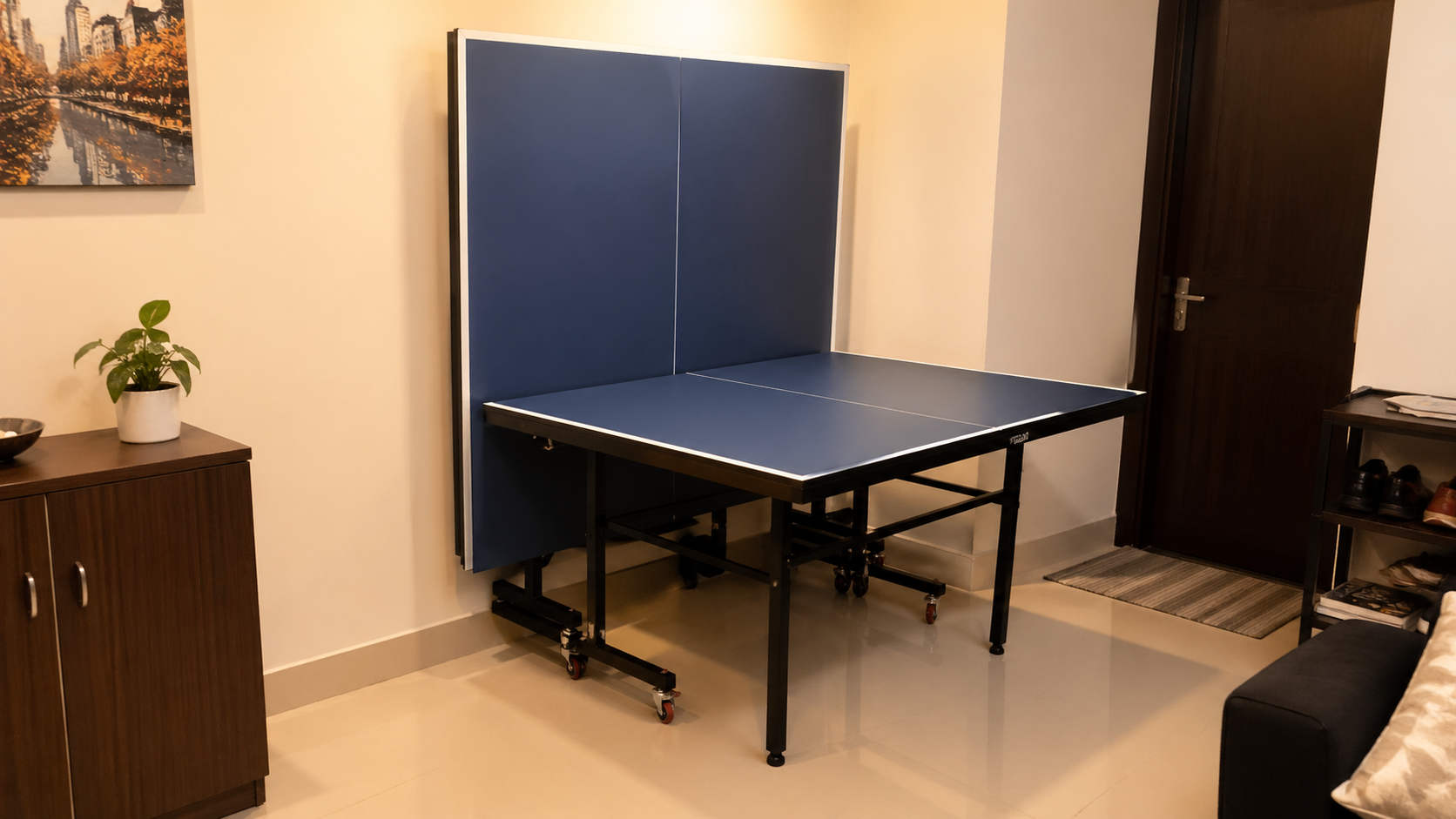
Indian homes rarely have dedicated game rooms. A foldable table tennis table is not a luxury — it is a necessity for most buyers.
Two-Piece Foldable Design
The most common design splits the table into two halves, each with its own set of legs and wheels. You fold each half upright and roll them to a wall or corner. This design also enables "playback mode" — fold up one half and practise solo by hitting against the vertical surface. When folded, a full-size table typically occupies a space of roughly 155 x 76 x 160 cm (width x depth x height), which fits against most walls.
One-Piece Fold Design
Some tables fold in one piece — the two halves fold together like a book. These are quicker to set up and store but are heavier to move and do not support playback mode. They are less common in India.
Wheels and Locking Mechanisms
Good wheels matter more than you think. A full-size table weighs 60-100 kg, and you will be moving it regularly. Look for tables with at least four swivel casters (ideally rubber-coated to protect flooring) and reliable locking brakes. The folding mechanism should have a safety lock to prevent the table from collapsing during play — especially important if children are around.
Space Requirements for Indian Homes
Space is the number-one constraint for Indian buyers. Here is a realistic breakdown:
- Minimum for full-size (recreational): 17 x 13 ft (5.2 x 4 m). This gives you 4 ft behind each end and 3 ft on each side. Tight but playable for casual rallies.
- Comfortable for full-size: 20 x 14 ft (6 x 4.3 m). Enough room for proper footwork and backswing without hitting walls.
- ITTF recommended (competition): 33 x 16.5 ft (10 x 5 m) playing area. Not realistic for home use but useful to know if you are setting up a club or coaching academy.
- Ceiling height: Minimum 9 ft (2.7 m). Most Indian homes have 9-10 ft ceilings, which is adequate. Lobbying high balls needs more headroom — 10 ft is ideal.
Common Indian home spaces that work: a large living room (when furniture is moved aside), a covered terrace or balcony (with an outdoor table), a garage or parking area (if covered), or a dedicated multipurpose room. Measure your space before buying — it is the most common source of regret among Indian buyers.
Surface Finish and Coating
The playing surface has a specific blue or green matte coating that determines ball grip, visibility, and glare reduction. Here is what to look for:
Blue vs Green
Blue is the modern ITTF standard for competition tables and the preferred colour for TV broadcasts. Green is the traditional colour and still widely used in clubs and homes. Performance-wise, there is no difference — it is purely about visibility and preference. Blue tables look more contemporary; green tables have a classic feel.
Anti-Glare Coating
Quality tables have a matte anti-glare coating that prevents light reflections from obscuring the ball. This is especially important if your playing area has overhead tube lights or windows that let in direct sunlight — both common in Indian homes. Budget tables sometimes have a semi-gloss finish that creates annoying glare spots.
Assembly and Installation
Most table tennis tables arrive partially assembled — the top halves are complete, and you need to attach the legs, wheel assemblies, and net. Budget 1-2 hours for assembly with two people. Some tips specific to Indian buyers:
- Check for delivery damage: Large items shipped across India often arrive with minor cosmetic damage. Inspect all edges and corners before the delivery person leaves.
- Keep the packaging: If you might need warranty service, the original packaging makes return shipping much easier.
- Level the table: Indian floors are not always perfectly level. Use the adjustable leg levellers (most tables have them) to ensure the playing surface is flat. Place a ball on the table — it should not roll in any direction.
- Net quality: Most bundled nets are basic. Upgrading to a screw-clamp net from Stag or Butterfly (INR 400-800) is a worthwhile improvement.
Indian Brands and Where to Buy
The Indian table tennis table market is served by a mix of domestic manufacturers and imported brands. Here are the key names:
Stag
The most established Indian TT brand. Stag manufactures tables across the entire price spectrum, from recreational models at INR 10,000 to ITTF-approved competition tables used in national championships. Their Club, Championship, and International lines are well-regarded. Stag tables are widely available on Amazon.in, Flipkart, and through sports distributors.
Donic
German brand with strong Indian distribution. Donic tables offer excellent build quality in the mid to premium range (INR 20,000-80,000). Their Waldner Highschool and Persson series are popular in Indian clubs and academies.
Butterfly
Japanese brand that produces the gold standard in professional tables. Butterfly tables are expensive (INR 50,000+) but deliver unmatched bounce quality and durability. The Butterfly Centrefold and Europa series are used in international competitions. Available through specialist dealers and online.
Budget Options: Koxtons, Gymnco
For buyers on a tight budget, Indian brands like Koxtons and Gymnco offer functional tables in the INR 8,000-15,000 range. Bounce quality and build are a step below Stag, but they serve the recreational market adequately. Explore our best table tennis tables in India review for detailed comparisons.
Budget Ranges for Table Tennis Tables in India
| Budget (INR) | What You Get | Top Thickness | Brands |
|---|---|---|---|
| 8,000 - 15,000 | Basic foldable, recreational | 12-15 mm | Koxtons, Gymnco, Stag (basic) |
| 15,000 - 30,000 | Good foldable, decent bounce | 15-18 mm | Stag, Donic (entry) |
| 30,000 - 60,000 | Club-quality, excellent bounce | 18-22 mm | Stag Championship, Donic |
| 60,000 - 1,50,000+ | Competition-grade, ITTF-approved | 22-30 mm | Butterfly, Stag International, Donic |
For most Indian home buyers, the INR 15,000-30,000 range offers the best balance of quality, features (foldability, wheels), and bounce consistency. Below INR 15,000, you are making significant compromises. Above INR 30,000, improvements become incremental unless you need competition-standard specifications.
Checklist Before You Buy
- Measure your room — including door widths (can the table fit through?) and ceiling height.
- Decide indoor vs outdoor — this narrows your options significantly.
- Check the top thickness — aim for 18 mm minimum if you want realistic bounce.
- Verify foldability — confirm the table supports playback mode if you want solo practice.
- Read the net situation — most tables include a basic net. Budget INR 400-800 for an upgrade if needed.
- Factor in delivery — these are large, heavy items. Confirm that the seller delivers to your floor (especially important for apartment dwellers).
- Check the warranty — Stag and Donic offer 1-2 year warranties on frame and surface. Verify terms before purchasing.
Related Reads
Frequently Asked Questions
What size table tennis table do I need for home use?
A full-size table (9x5 ft / 274x152.5 cm) is the standard for proper play. If space is tight, a 3/4 size table (7x4 ft) is a reasonable compromise. Mini tables (5x3 ft or smaller) are for casual fun only — you cannot develop proper technique on them.
How much space do I need around a table tennis table?
For recreational play, you need at least 4 feet of clearance on each end and 3 feet on each side — so a room of roughly 17x13 feet minimum for a full-size table. For competitive practice, ITTF recommends 19x10 feet of clear playing area beyond the table itself.
Is a thicker table top always better?
Yes, within reason. Thicker tops (19-25 mm) provide a more consistent, higher bounce that feels closer to professional tables. Tables under 15 mm thick often have uneven bounce and a dead feel. For serious home practice, aim for at least 18 mm.
Can I keep a table tennis table outdoors in India?
Only if it is specifically designed for outdoor use. Outdoor tables use aluminium composite or melamine-coated tops that resist moisture and UV damage. Standard MDF indoor tables will warp, swell, and degrade quickly in Indian outdoor conditions, especially during monsoon season.
Which Indian brands make good table tennis tables?
Stag is the most established Indian table tennis table brand with models from INR 10,000 to over INR 1,00,000. Donic (through their Indian distributor) and Butterfly also have good options. For budget tables, Koxtons and Gymnco offer functional tables under INR 15,000.
Is a foldable table tennis table worth it?
Absolutely, especially for Indian homes where dedicated game rooms are rare. A foldable table with wheels lets you store it upright when not in use, freeing up the room for other purposes. Most foldable tables also support playback mode where you fold up one half to practise solo.