Best under ₹2,000 9.3
GKI Offensive XX
₹949
TTFI-approved with Speed 92, Spin 92 and Control 96, at 195 g with a cover. The most reviewed bat in Indian table tennis, and owners routinely report five to ten years of service.
The winner from each of our two racket brackets, plus the balls and tables to go with them — scored on what Indian buyers actually reported.

The best table tennis racket in India for most players is the GKI Offensive XX at ₹949 — the number one Amazon bestseller in the category, TTFI-approved, with 4.4 stars across more than 5,300 reviews and long-term owners reporting five to ten years from a single bat. If you have outgrown it, the TANSO Black X Blade Pro at ₹2,199 gives you ALC carbon construction for less than most rivals charge for plain wood.
Table tennis is India's most accessible indoor sport — society basements, coaching academies, corporate recreation rooms, DSO tournaments — and it is also the racket sport where the cheapest sensible option is genuinely very cheap. The catch is that the sub-₹2,000 shelf mixes TTFI-certified bats with unbranded imports at almost identical prices, and nothing in the listing tells you which is which.
One thing to know before you start: the rubber matters more than the blade. It is what generates spin, it is what wears out, and it is where the difference between a certified bat and an uncertified one actually shows up in your game.
The winner from each of our 2 price brackets. Every one came first in a full head-to-head roundup, not a shortlist.
₹949
TTFI-approved with Speed 92, Spin 92 and Control 96, at 195 g with a cover. The most reviewed bat in Indian table tennis, and owners routinely report five to ten years of service.
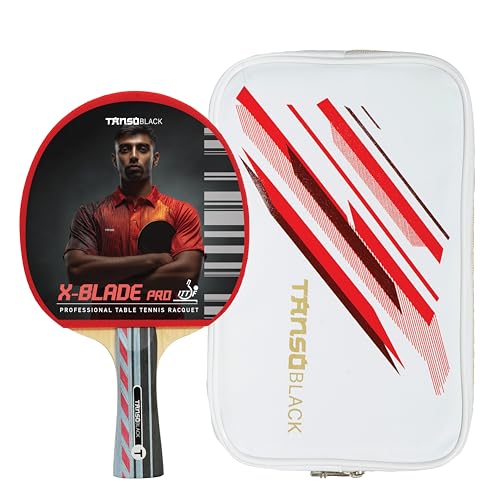
₹2,199
ALC carbon construction at a price where the competition is still selling plain wood — a larger sweet spot and more consistent power for an improving club player.
Scores are not comparable across brackets. Each racket is scored against the others at its own price, so the 9.3 under ₹2,000 and the 9.4 under ₹5,000 are not making the same claim. Note that our sub-₹2,000 pick outscores several bats costing twice as much on spin and control — spending more is not automatically an upgrade in this sport. Prices are what the Amazon.in product pages showed on 29 August 2026.
Each bracket has its own full roundup — every contender scored, specced and priced, with the ones that did not make the cut and why.
Under ₹2,000
Beginners, society play and coaching academies
A cluttered shelf where TTFI-certified bats sit beside unbranded imports within a few hundred rupees of each other. GKI, based in Meerut, dominates it — and in head-to-head reviews their bats repeatedly outperform bigger international names at the same price.
Under ₹5,000
Club players who have outgrown a basic bat
Where casual players become competitors — carbon-reinforced blades, ITTF-approved rubber and sponge thicknesses worth paying attention to. Butterfly, DONIC and GKI compete here with newer Indian challengers, and the price gaps do not map neatly onto performance.
It is the rubber that generates spin, and it is the rubber that wears out — usually long before the blade does. A premium blade with tired rubber plays worse than a modest blade with fresh rubber, which is why re-rubbering after a year or two of intensive play is normal rather than a sign you bought badly.
ITTF or TTFI approval is the quality floor worth insisting on. It certifies thickness and consistency, and it is what makes a bat eligible for organised play. Uncertified bats are fine for family games and cannot be used in DSO events, academy tournaments or club competition.
Manufacturers rate bats on Speed, Spin and Control, usually out of 100. Beginners should prioritise Control above 90 and treat high Speed as a liability rather than a feature — a fast bat punishes an unformed stroke and slows down how quickly you learn one.
Intermediate players want the three roughly balanced. Do not take the numbers entirely on trust: they are set by the manufacturer, and they are worth cross-checking against what Indian buyers report about spin and durability in practice.
Carbon layers add speed and cut weight, and at the sub-₹2,000 level that comes at a real cost in feel. Entry-grade carbon laminated with cheap wood is repeatedly described by experienced players as hollow or lifeless on impact, and the all-wood bats at the same price generally beat it outright on spin and control.
Carbon starts earning its place around ₹2,000 and above, where higher-grade layups such as ALC are paired with better rubber. Below that, a 5- to 7-ply all-wood blade is the better buy for almost everyone.
Bats in this market run from about 150 g to 300 g. Around 180–200 g is heavy enough to develop proper stroke mechanics and generate power, and light enough to keep forehand-to-backhand transitions quick.
Very light bats near 150 g are comfortable for children but lack the mass to build a real swing, and you will outgrow one quickly. Anything above 250 g causes wrist fatigue and pain, particularly on backhand transitions, and should be avoided by beginners entirely.
Indian heat and humidity are hard on table tennis rubber, and exposed rubber degrades noticeably faster than covered rubber. Store the bat in its cover — and check whether one is included, because several rackets in the ₹2,000–₹5,000 band do not come with one and you should budget ₹200–₹400 if not.
Wipe the rubber with a damp sponge after playing to keep it tacky, apply side tape to stop edge chipping, and keep the bat out of direct sunlight. Owners who do this routinely report five years or more from a sub-₹1,000 bat; owners who do not replace rubber in a year.
Table tennis has the flattest price curve of any racket sport sold in India, and understanding where it flattens saves real money.
Under ₹2,000 you are buying a competent pre-assembled bat. The blade is plywood, the rubber is basic and usually not ITTF-approved, and the whole thing is glued together at the factory. For recreational play, office tables and learning the sport, this is genuinely enough, and the gap between a ₹700 bat and a ₹1,800 one is smaller than the price difference implies.
Under ₹5,000 you are buying better rubber and a more consistent blade. This is where ITTF-approved rubbers, tidier construction and occasionally carbon layers appear. The rubber is what you are really paying for, and on a pre-made bat it is also the part you cannot change.
Above that, the market changes shape rather than simply getting more expensive: serious players stop buying pre-made bats and start buying a blade and two rubbers separately, assembling the bat themselves. That is the genuine upgrade path in table tennis, and it is why the pre-made shelf thins out so noticeably at the top.
The practical consequence for most Indian buyers is that spending ₹4,500 rather than ₹1,500 on a pre-made bat buys less than the price gap suggests. If you have reached the point where your bat is genuinely limiting you, the answer is usually a custom assembly rather than a more expensive pre-made one.
Almost every table tennis racket sold in India is pre-made — blade and rubbers bonded at the factory, sold as one object. Almost every racket used competitively is not. Knowing which market you are shopping in prevents the most common overspend in the category.
A pre-made bat is convenient, cheap and immediately playable. Its limitation is that the rubber is fixed: when it wears out, which it will within one to two years of regular play, the whole bat is effectively finished. You are also accepting whatever rubber the maker chose, which on cheaper bats is selected for cost rather than for playing characteristics.
A custom assembly means choosing a blade for speed and feel, then choosing a forehand rubber and a backhand rubber — often different ones, because the two strokes want different things — and having them glued on. It costs more up front, typically ₹3,000–₹8,000 for a sensible first setup, and it is the only way to get a genuinely good combination. Crucially, when the rubber dies you replace the rubber at a fraction of the cost, and the blade lasts many years.
The switching point is clear enough: when you can consistently loop or drive with spin and you have a view about what you want your bat to do differently, you have outgrown pre-made. Before that, a decent pre-made bat is the right purchase and a custom setup is money spent on distinctions you cannot yet feel.
Table tennis handles come in distinct shapes, and the choice is more consequential than in other racket sports because it changes which strokes are comfortable.
Shakehand is the dominant grip worldwide and in India — held like a handshake, with a forehand and backhand on opposite faces. It gives balanced coverage on both wings and is what almost all pre-made bats and almost all coaching assume. Unless you have a specific reason, this is the grip to learn.
Within shakehand, handles come as flared (widening at the base, the most common and most secure for beginners), straight (even width, favoured by players who rotate the bat between strokes), and anatomic (contoured to the palm, a matter of preference).
Penhold is held like a pen, giving an exceptionally strong forehand and wrist flexibility, at the cost of a structurally awkward backhand that requires specific technique to cover. It remains common in parts of Asia and is a legitimate style, but coaching for it is scarce in India and penhold-specific bats are hard to find here.
The practical advice is unglamorous: learn shakehand with a flared handle, because it is what the equipment on Indian shelves is built for and what any coach you find will teach. Switching grip style later is a substantial technical project, so this is worth being deliberate about at the start rather than discovering by accident which grip your bat encourages.
Table tennis in India is played in a wider range of settings than any other racket sport — clubs, offices, schools, housing society common rooms and living rooms — and the setting should drive the purchase more than it usually does.
On an office or society table, which is likely to be a lower-grade surface with an inconsistent bounce, an expensive bat is largely wasted. The table is the limiting factor, and a ₹800 bat plays about as well as a ₹4,000 one on a surface that is not returning a true bounce. Spend on balls instead.
In a club with a proper 25 mm table, equipment differences become visible, and this is where a ₹2,000–₹5,000 bat starts to earn its price.
Outdoors — increasingly common on concrete tables in Indian parks and societies — humidity, dust and sun are brutal on rubber. Use an older bat, keep it covered, and accept that the rubber will die faster than it would indoors. Outdoor-specific bats with plastic-faced surfaces exist and are genuinely more sensible in that setting than good rubber.
Balls matter more than most buyers think. Modern balls are 40 mm plastic, graded one to three stars; three-star is the competition grade and is rounder and more consistent. Cheap unbranded balls are frequently out of round, which produces erratic bounce that gets blamed on the bat or the player. A box of three-star balls costs little and improves every session.
Table tennis rewards technique and practice more steeply than equipment, and the spending order reflects that.
Table access comes first. Regular play on a decent table is the whole game, and it is the constraint for most Indian players — a good bat used monthly loses to an average bat used weekly, every time.
Three-star balls are second, and they are absurdly under-bought. Out-of-round cheap balls make the game unpredictable in a way that actively slows learning, because you cannot build consistency against inconsistent equipment.
Coaching is third. Table tennis has enormous technical depth — the difference between pushing the ball back and generating topspin is not something most players find on their own — and a few sessions early changes the ceiling substantially.
Rubber care is fourth, and it is free. A cover, a wipe with a damp sponge after playing, side tape, and keeping the bat out of Indian sun and heat routinely triples how long a bat lasts. This is the highest-return habit in the sport.
The bat itself is fifth. A sound ₹1,500–₹2,500 pre-made bat is enough for the large majority of Indian recreational players, and the right next step for those who genuinely outgrow it is a custom blade-and-rubber assembly rather than a more expensive pre-made one.
The two sides of a table tennis bat must be different colours — black on one face and a distinct colour, usually red, on the other — and the reason is that they are allowed to be different rubbers with genuinely different behaviour. Your opponent needs to be able to see which one you are about to use.
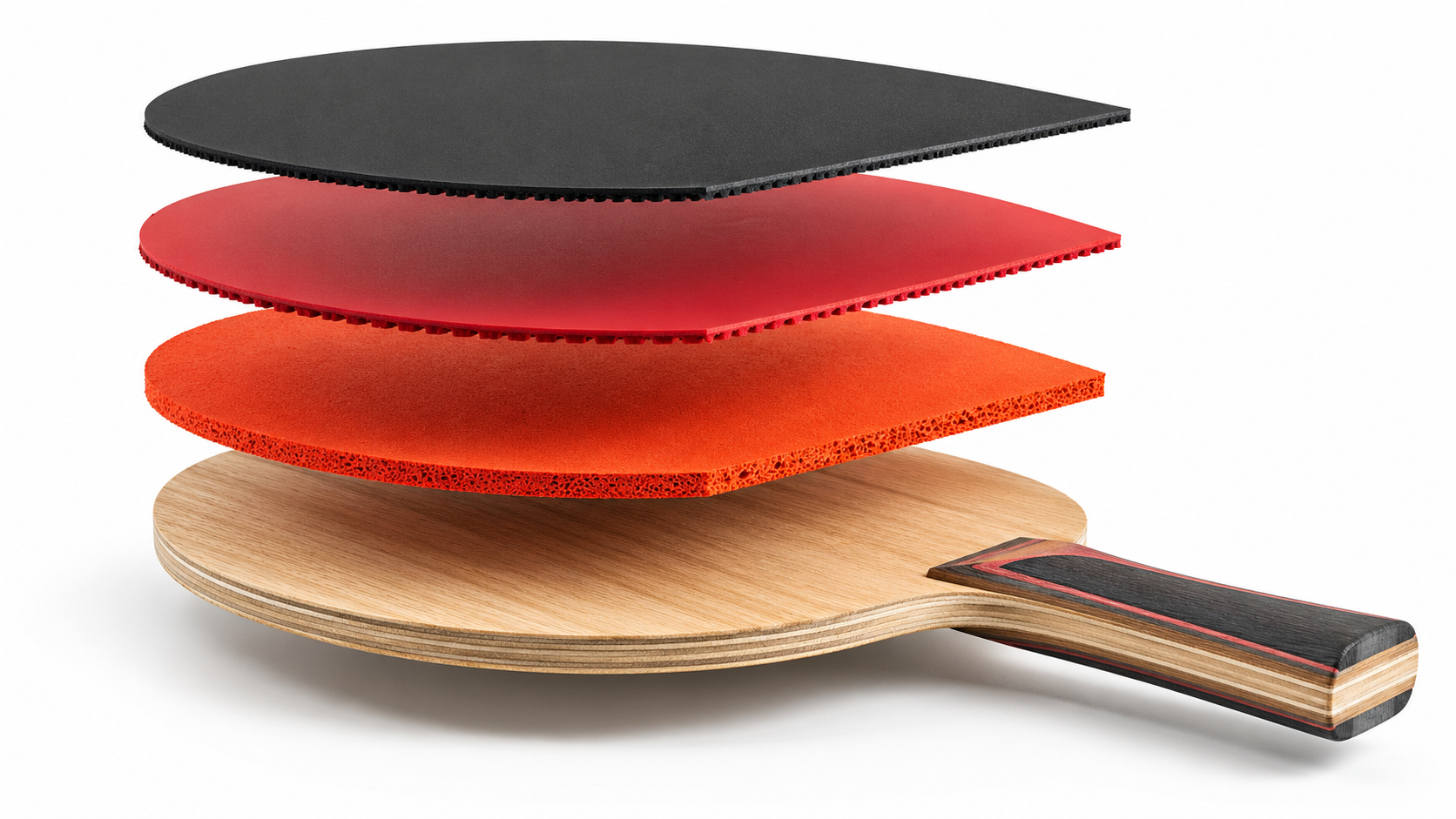
Inverted, or pimples-in, is the smooth surface almost every pre-made bat carries on both sides. The pimples face inward against the sponge, leaving a smooth, tacky outer surface that grips the ball. It generates the most spin, both when you apply it and when you receive it, and it is what essentially every attacking player uses. If you are learning, this is what you want on both sides.
Short pimples-out presents the pimple tips to the ball. It grips less, so it produces less spin of its own and — crucially — is far less affected by the spin your opponent puts on the ball. It suits fast, flat hitting close to the table.
Long pimples are a specialist defensive surface whose flexible pimples bend on contact and return the ball with reversed or unpredictable spin. They are genuinely disruptive against inexperienced opponents and require a completely different playing style to use well.
The relevant advice for most buyers is simple: stay on inverted rubber both sides while you are learning. Pimpled surfaces can win points against beginners immediately, which makes them tempting, and they do so by avoiding the spin skills that determine how good you eventually become. Sponge thickness matters too — thicker sponge, around 2 mm, gives more speed and spin but less control, while 1.5 mm and below is slower and more controllable and suits a developing player.
On a pre-made bat the blade is invisible and rarely specified, but it is half of what you are holding, and understanding it makes the step to a custom setup far less intimidating.
A blade is a laminate of thin wood veneers, usually five or seven plies, sometimes with one or two layers of carbon or other synthetic fibre between them. More plies and stiffer wood mean more speed and a harder, more direct feel; fewer plies and softer wood mean more control and more feedback through the handle, because the blade flexes and holds the ball fractionally longer.
A five-ply all-wood blade is the classic learning setup and remains the sensible default. It is slow enough to keep the ball on the table while you are developing a stroke, and communicative enough that you can feel what the ball is doing. Almost every serious coach starts players here, and many club players never need to leave.
Carbon layers add speed and enlarge the sweet spot by stiffening the blade, which sounds unambiguously good and is not. A stiffer blade gives less feedback and is less forgiving of a stroke that is still being learned — it will send a slightly mistimed ball long rather than letting you feel the error. Carbon suits a player whose technique is already consistent and who wants more speed from the same swing.
This is the same pattern that runs through every section on this page: the faster, stiffer, more advanced-sounding option is genuinely better for a player who has the technique to use it, and genuinely worse for one who does not. Buy the slower blade and grow into speed, rather than buying speed and hoping to catch up to it.
Sets at ₹500–₹800 optimise for the count on the box: thin rubber with no tack, low-grade wood with fewer plies, and minimal sponge, which together produce poor spin and inconsistent bounce. A single certified bat at ₹949 will comprehensively outplay both bats in any set at a similar combined price. Buy one properly and borrow the second at the club.
Table tennis is unusual among racket sports in that the sub-₹1,000 bat is genuinely competitive. Our ₹949 pick outscores several bats at nearly double the price on both spin and control, and reviewers of rival brands routinely recommend it over their own purchase. Move up when your technique has actually outgrown the bat, not on price alone.
Reviews across several brands describe receiving a different or counterfeit product than the listing showed — most often on older international model names. Open the box and check the rubber quality, the handle construction and the branding immediately, while the return window is still open. This is the one check that costs nothing and saves the most.
In-depth guides to help you pick the right racket and understand the specs.
Roundups outside the racket price brackets above.
We compared 10 table tennis balls available in India — from ₹33/ball Tanso to ₹216/ball Butterfly. Here are the 7 best picks with scores, specs, and real prices.
Top Pick
Tanso T40 3 Star Table Tennis Balls (Pack of 6) · ₹199
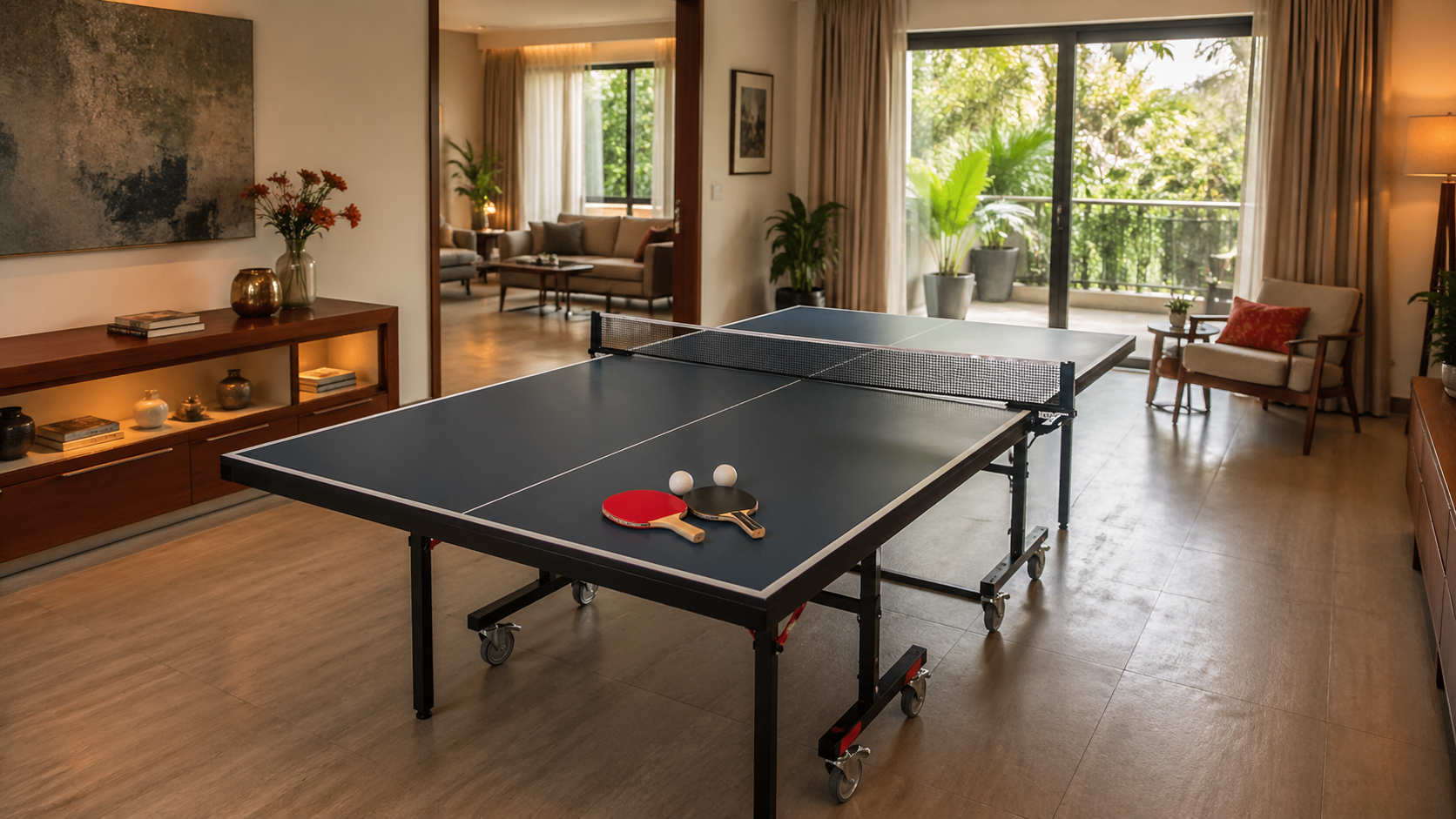
We compared 5 full-size TT tables from STAG, GYMNCO, Step Over, and Deuce. Here are the best options for home, office, and club use — with real prices and specs.
Top Pick
Step Over Tournament Pro 25mm · ₹18,499
We don't run paid placements and we don't accept free products. Every pick on this page comes from a roundup where we compared the full field on manufacturer specifications, independent expert reviews, and the verified buyer feedback left by Indian customers — weighting Indian evidence heavily and discounting star ratings built on buyers in other markets.