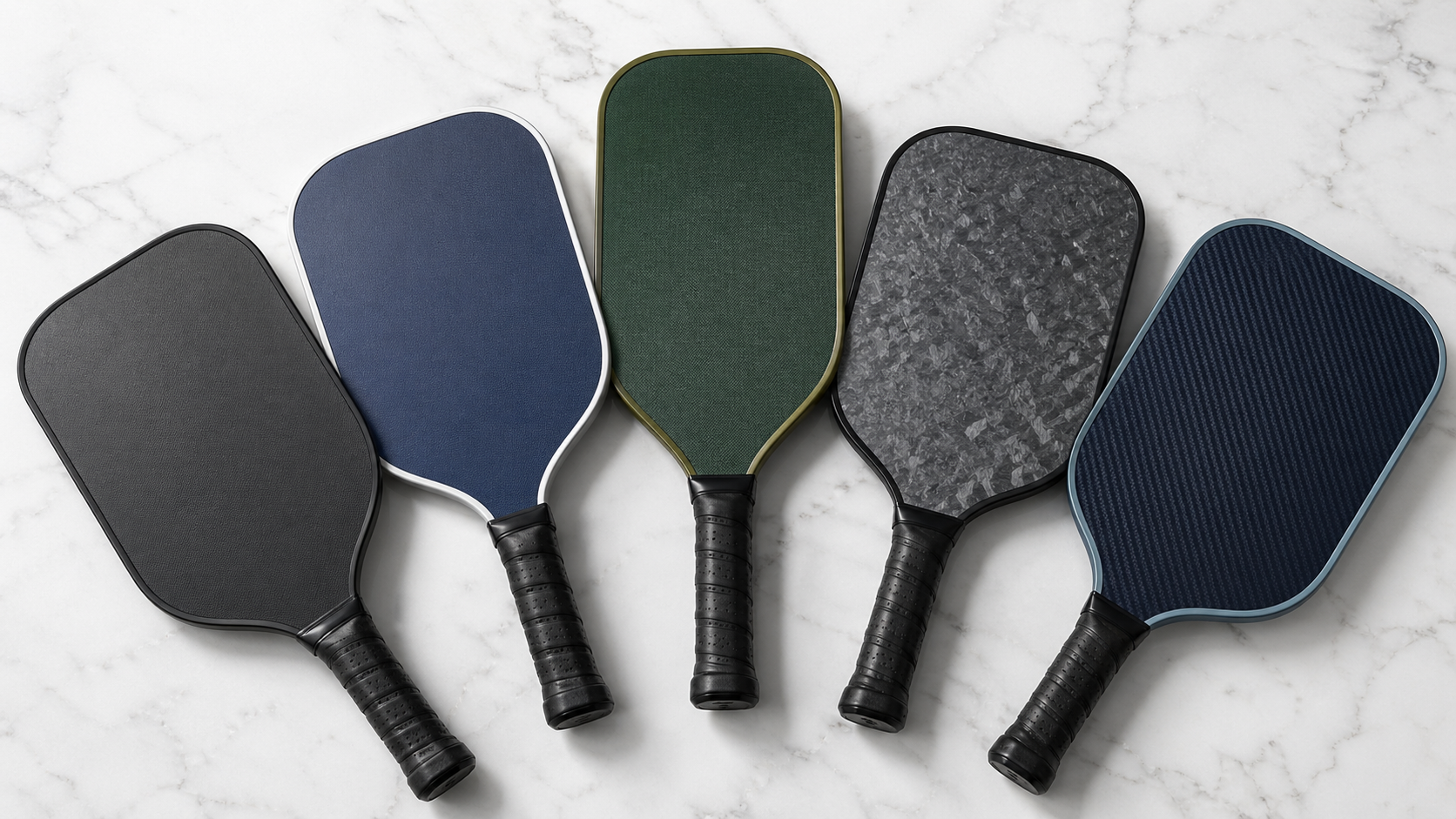
The winner from each of our three price brackets — every one with genuine Indian owners behind it, not a global star count.
Last updated: 3 picks · 3 in-depth reviews
Researched & written byNaveen Bhavnani · Founder & Lead Researcher
We may earn a commission via Amazon.in or Flipkart affiliate links. This doesn't affect our ratings.
Prices checked on 29 August 2026 — each price is what the Amazon.in product page showed on that date.
Short answer
The best pickleball paddle in India is the FirstEdge AeroFusion at ₹6,978 — an edgeless thermoformed paddle with a genuine Japanese Toray T700 raw-carbon face and the most forgiving sweet spot in its field. For a first paddle, the YAIT Xtrieve T700 at ₹2,299 is the only real raw-carbon paddle in the budget band. In between, the COLISEO Ultimus at ₹4,599 gives you thermoformed T700 construction for well under ₹5,000.
Pickleball is the fastest-growing racket sport in India — Bengaluru tech parks, Mumbai community courts, new clubs opening every month — and the paddle market has grown faster than the evidence base behind it. Amazon.in is full of paddles carrying hundreds of glowing ratings and not one review from India: US-market listings whose warranty and after-sales support do not meaningfully exist here.
That is the filter we apply. Every paddle below has genuine Indian owners, and every "carbon" claim has been checked against the spec table rather than the title — because in the budget band, most paddles marketed as carbon are fibreglass or a composite.
Our Pickleball Picks at Every Budget
The winner from each of our 3 price brackets. Every one came first in a full
head-to-head roundup, not a shortlist.
The only genuine Toray T700 raw-carbon face in the budget band, with a 3K-grit frosted surface for real spin and a 5.3in handle for two-handed backhands. Handle it gently — several buyers report the handle snapping.
Thermoformed unibody construction and a genuine T700 raw-carbon face at a price where most paddles are still painted-grit composites. The 16mm core keeps it forgiving at the net.
The widest, most forgiving sweet spot in the premium band, thanks to an edgeless thermoformed unibody — and the strongest genuine Indian review base of any paddle we looked at.
Scores are not comparable across brackets. Each paddle is scored against the others at its own price, so the 9.3 under ₹2,500 and the 9.5 under ₹10,000 are not making the same claim — the first means "outstanding for ₹2,299", the second "outstanding for ₹6,978". Prices are what the Amazon.in product pages showed on 29 August 2026.
Choose by Budget
Each bracket has its own full roundup — every contender scored, specced and priced, with the
ones that did not make the cut and why.
Check for Indian reviews before you check the star rating
This is the single most useful habit in Indian pickleball. Amazon.in shows a global rating count, and the category is full of paddles with hundreds of enthusiastic US and UK reviews and not one from India — Palms-O-Aces, Professor PhD, niupipo and several global JOOLA SKUs among them.
These are US-market listings. The warranty and after-sales support behind them do not practically exist for an Indian buyer, and nobody here has tested how they hold up. Scroll past the headline stars to look for a genuine "Reviewed in India" section before you trust anything.
Raw carbon is what gives you spin, and it is often not what you are buying
Spin comes from the texture of the hitting surface. Genuine raw Japanese Toray T700 carbon has a naturally gritty weave that grips the ball and keeps doing so for years. Painted or sand-applied grit spins well when new and smooths out with play, and fibreglass never had much to begin with.
Under ₹2,500 the majority of paddles advertised as carbon are fibreglass or a composite. Read the spec table's material field, not the title. Quality fibreglass is a perfectly good first paddle — more forgiving, often more durable and cheaper — but buy it knowing that is what it is.
16mm for control, 13mm for power
Core thickness is the biggest difference in how a paddle feels. A 16mm core is softer with a larger sweet spot, which makes dinks, resets and control at the kitchen line far easier — most beginners play better with it. A 13mm core is firmer and faster, giving more pop and hand speed for players who want to drive the ball.
Neither is better in the abstract. Pick for the game you actually play, and remember that a widebody shape enlarges the sweet spot at either thickness.
Handle length decides whether you can hit a two-handed backhand
If you hit a two-handed backhand — or want to — you need an elongated handle of about 5.3 inches or more. Short-handled paddles around 3.25 inches are fine one-handed and cramped for a two-hander, and this is not something you can work around.
Grip circumference around 4.25 inches suits most Indian hands. You can always build a grip up with an overgrip; you cannot meaningfully shrink one. On weight, aim for 200–235 g: under about 180 g feels flimsy with no plough-through, and 250 g and up tires your arm across a long session.
Thermoformed builds last longer — but still read the edge reviews
A thermoformed unibody moulds the paddle as a single piece, and foam-injected edge walls absorb impact and widen the sweet spot. It is the clearest durability difference in the category, which is why every one of our picks is thermoformed.
It is not a guarantee. Even thermoformed paddles draw reports of the edge opening after a couple of months of heavy play. Check the one- and three-star Indian reviews for that specific complaint, look for a metal end cap and a proper edge guard, and read the warranty: most brands here offer only 60 days, though a few stretch to a full year.
What each price bracket actually buys you
Pickleball is the newest racket sport in India and its pricing is the least settled, which makes it unusually easy to overpay. Each of the three brackets below changes something specific.
Under ₹2,500 you are buying a playable paddle, and not much more. Expect fibreglass or a composite face over a polymer honeycomb core, a cold-pressed build, and a surface that will lose whatever grit it started with within a few months. That is genuinely fine for learning the sport and working out whether you like it. What you should not expect is meaningful spin or a durable edge.
Under ₹5,000 you are buying surface quality and construction. This is where genuine raw carbon faces and thermoformed unibody construction start appearing, and both are real, felt differences — carbon grips the ball for spin in a way fibreglass does not, and a thermoformed edge survives being clipped on the court. For most Indian club players this bracket is the sweet spot and the sensible place to stop.
Under ₹10,000 you are buying refinement and consistency: better foam edge walls, more carefully controlled weight and balance, longer warranties, and a sweet spot that has been engineered rather than inherited. The gains over a good ₹4,500 paddle are real but modest, and they only matter to a player who is already consistent enough to notice them.
The thing to resist is the assumption that pickleball pricing works like tennis. A ₹9,000 paddle is not a fundamentally different class of object from a ₹4,000 one in the way a ₹19,000 tennis racket is from a ₹3,000 one. The curve flattens much earlier here.
Paddle shape changes reach, power and forgiveness
Paddle shape is regulated — length plus width cannot exceed 24 inches, and length cannot exceed 17 inches — which means every shape is a trade between reach and sweet spot. Makers rarely explain which trade they have made.
A standard or widebody paddle (roughly 16 inches long, 8 inches wide) puts the mass in a broad face with a large, centrally placed sweet spot. It is the most forgiving shape and the right default for a beginner or for a player who spends most of the game at the kitchen line hitting dinks and blocks.
An elongated paddle (about 16.5 inches long, 7.5 inches wide) trades width for length. You gain reach and leverage, which means more power on drives and serves and a better chance of getting to a ball at full stretch. You lose sweet-spot width, so off-centre hits are punished harder, and the extra length raises swingweight, which makes the paddle slower in fast hands battles at the net.
A hybrid sits between the two and is what most all-round players end up preferring.
The mismatch worth avoiding is a beginner buying an elongated paddle because it looks more serious. Pickleball is won and lost at the kitchen line in fast exchanges, and a shape that is slower to reposition and less forgiving on mishits is working against you in exactly the situation that decides most points.
Grip size and handle length are two different decisions
Pickleball paddle grips run roughly 4 to 4.5 inches in circumference, and unlike tennis there is no widely used standard sizing chart, so listings often state a measurement and leave you to interpret it.
The practical test is the same as tennis: hold the paddle in an eastern forehand grip and you should be able to slide the index finger of your other hand into the gap between your fingertips and the base of your thumb. If there is no room, the grip is too small; if the finger sits loosely, it is too big.
Err small. An overgrip adds roughly an eighth of an inch, costs ₹100–₹200 and takes two minutes; removing handle material is not practical. A grip that is slightly too small and built up is a solved problem, while a grip that is too large is a permanent one and a genuine contributor to wrist and elbow strain, because you cannot close your hand properly around it.
Handle length is a separate question and is mostly about whether you hit a two-handed backhand. A 5-inch handle fits two hands comfortably; a 4.5-inch one does not, and forces a cramped grip that costs you control. Handle length also trades directly against face length on an elongated paddle, so a long handle usually means a smaller hitting surface — which is a reasonable trade for a two-hander and a poor one for anybody else.
Weight is the spec beginners get wrong most often
Pickleball paddles run roughly 200 to 250 g, and that narrow-looking range covers a genuinely large difference in how the game feels.
A light paddle (under about 215 g) is fast in hand, which matters enormously in the rapid net exchanges that decide most pickleball points, and it is easier on the arm. The cost is that you have to supply all the power yourself, and balls hit off-centre get pushed around more by an opponent's pace.
A heavy paddle (above about 230 g) gives you free power and stability — it drives through the ball and does not twist on contact. The cost is speed at the net and, more seriously, load on the elbow and shoulder over a long session.
The midweight band, roughly 215–230 g, is where most players should be and where most good paddles are designed to land. It is the least likely to actively work against you.
The specific error worth naming: players coming from tennis often choose a heavy paddle because tennis rackets are much heavier and 230 g feels like nothing. But pickleball is played with the arm far more extended and with much less time between shots, and tennis elbow is a genuinely common complaint among converts. If you are coming from tennis, start lighter than instinct suggests.
The ball matters, and India mostly plays the wrong one indoors
Pickleball balls are not interchangeable, and using the wrong type is one of the quiet reasons a game feels off.
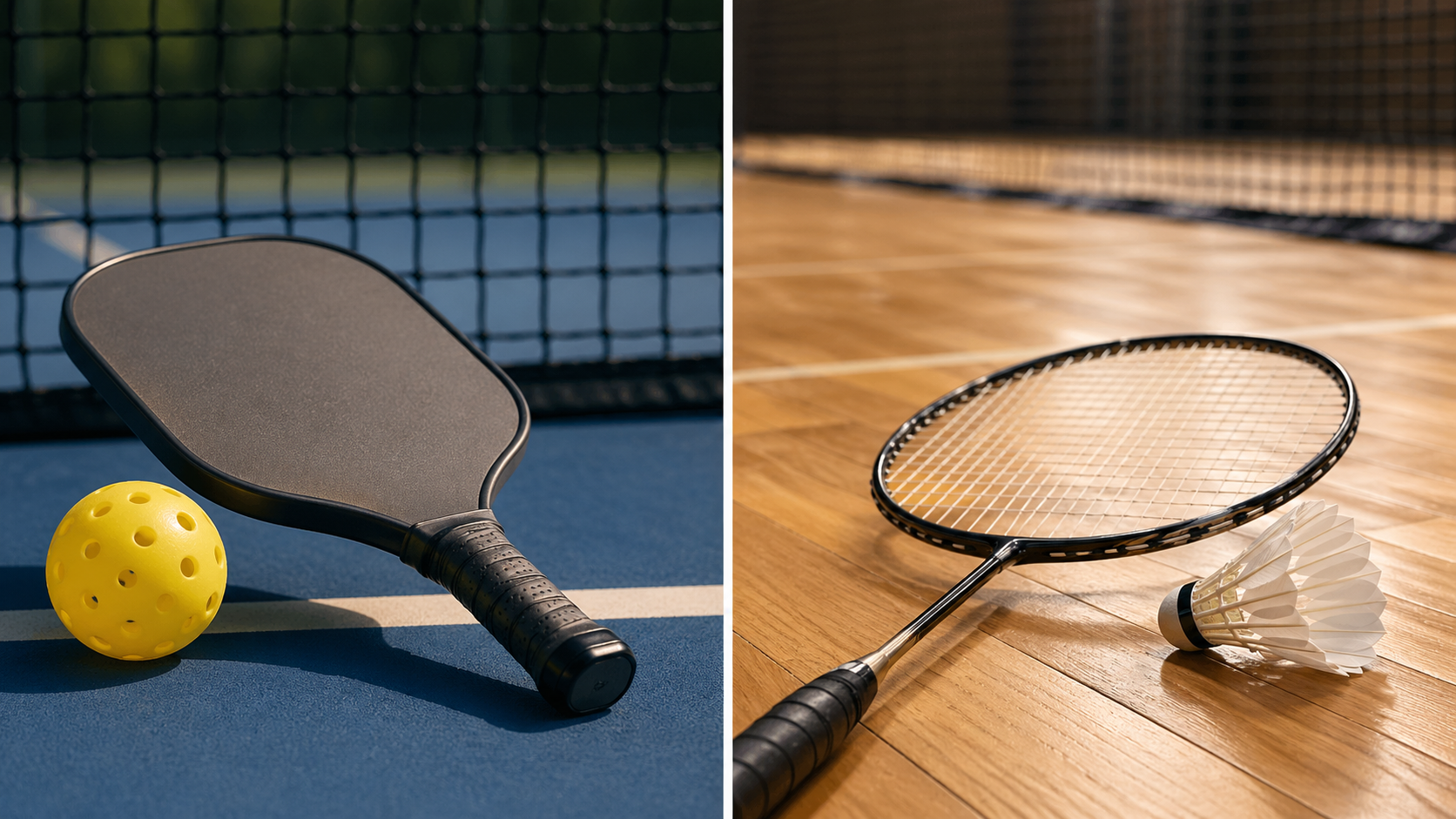
Outdoor balls are harder, heavier, and have more, smaller holes — typically 40. That makes them resist wind and bounce predictably on hard outdoor courts. They are also noticeably harsher on paddles and on the arm, and they crack rather than deform when they fail.
Indoor balls are lighter and softer with fewer, larger holes — usually 26. They are quieter, gentler on the paddle face, and they fly slower with more drag, which produces longer rallies. They deform and go soft rather than cracking.
In India, where a great deal of pickleball is played on repurposed badminton and basketball courts indoors, the outdoor ball still turns up constantly because it is what gets sold in multipacks. On an indoor surface it bounces high and fast and makes the game feel rushed and unforgiving, particularly for beginners.
Balls are cheap relative to paddles and they wear out — a cracked or out-of-round ball flies unpredictably and should be retired immediately. If your group is buying one thing to improve the quality of its games, a fresh box of the correct ball type is a better purchase than anybody's next paddle.
Playing pickleball in India: courts, shoes and surfaces
Pickleball has grown very fast in Indian cities and the infrastructure is still catching up, which shapes what equipment actually makes sense here.
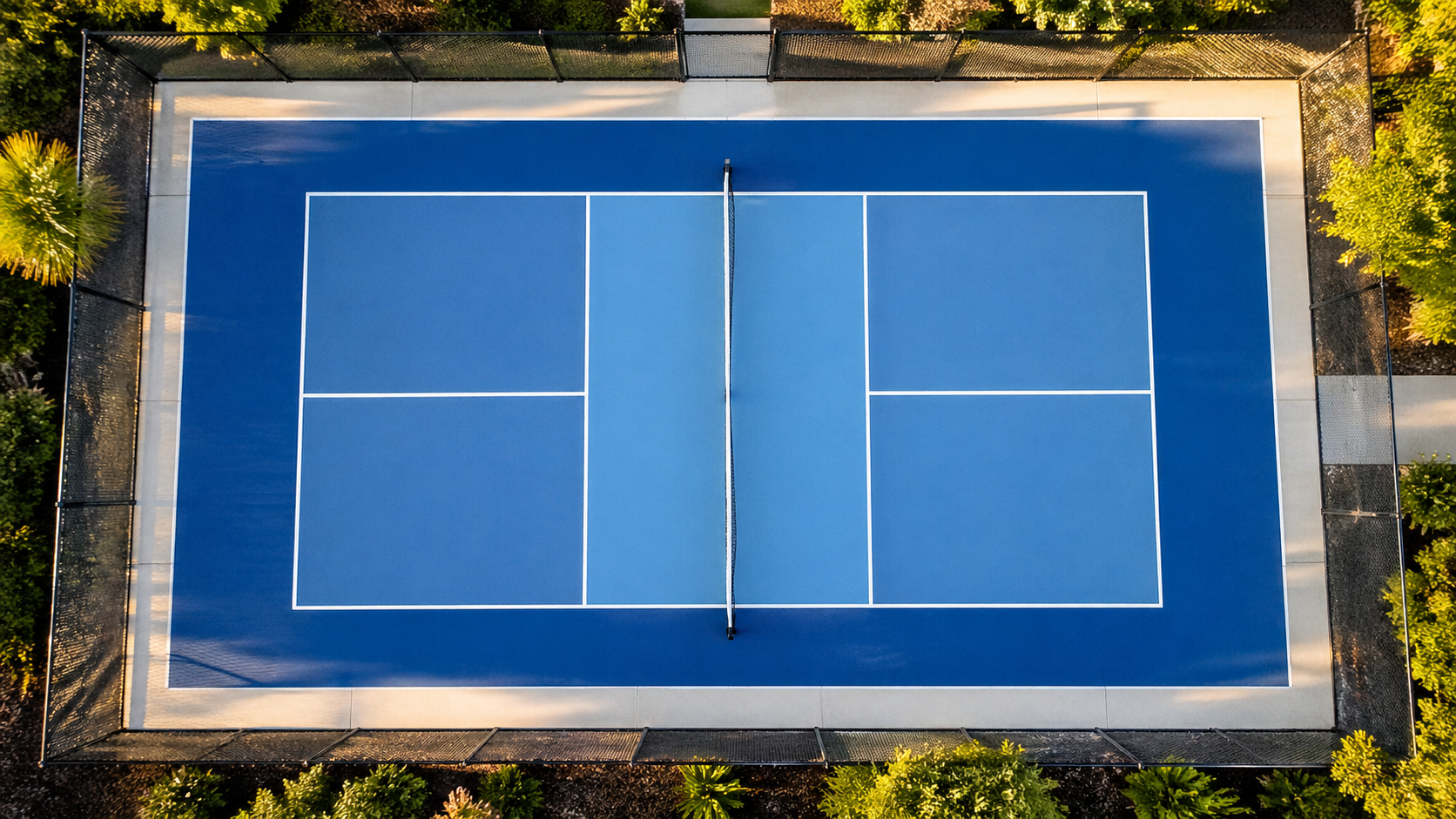
Most Indian pickleball is played on converted courts — badminton halls, basketball courts, and increasingly dedicated venues in Mumbai, Bengaluru, Delhi and Pune. A regulation pickleball court is 20 by 44 feet, which fits comfortably inside a badminton hall, and this is why the sport has scaled so quickly here: the venues already existed.
Wear court shoes, not running shoes. Pickleball involves constant short lateral movements and sudden stops in a small area, and running shoes have no lateral support and a raised heel that makes rolling an ankle easy. Badminton or tennis court shoes are both appropriate — badminton shoes for indoor wooden and synthetic floors, tennis hard-court shoes for outdoor concrete. This is the most common injury cause in a sport that markets itself as low-impact, and it is genuinely worth the ₹2,500–₹3,500.
Surface affects paddle wear. Outdoor concrete courts chew through paddle edges when you scrape the paddle picking up a ball, which is a routine part of the game. A metal end cap and a substantial edge guard are worth more outdoors than indoors, and the habit of scooping the ball with your paddle is worth breaking.
Noise is a real constraint. Pickleball is loud, and residential venues in Indian cities increasingly restrict playing hours because of it. Some paddles market themselves as quieter; the difference is modest, and the ball type affects it more than the paddle does.
How long a paddle lasts, and how to tell when it is done
Paddles wear out far faster than tennis or badminton rackets, and most Indian buyers do not expect that.
The face is what dies first. A raw carbon surface generates spin through a fine grit texture, and that texture wears smooth with use — faster on outdoor courts, faster with abrasive balls, and much faster on cheaper surfaces where the grit is a coating rather than the material itself. A paddle whose spin has quietly disappeared usually has not broken; it has gone bald. The test is simple: run a thumbnail across the face. If it no longer catches, the surface is finished, and no amount of technique will restore the spin.
The core softens next. Polymer honeycomb compresses gradually with impact, and an old paddle feels increasingly dead and hollow, sometimes with an audible rattle if the core has separated from the face. Delamination — face separating from core — shows up as a soft spot or a buzzing sound in one area, and a delaminated paddle is finished and, in organised play, not legal.
The edge is the visible failure. Edges open up where the guard has been scraped, and once moisture gets between the layers the paddle degrades quickly.
A realistic expectation for a regularly played paddle in India is one to two years, with the surface going well before anything structural. That is worth factoring into the buying decision: it argues for the ₹4,000–₹5,000 bracket over the ₹9,000 one for most players, because you will be replacing it sooner than you would replace a racket.
The mistakes that recur in Indian pickleball buying
Pickleball is new enough in India that most buyers have no reference point, and the same avoidable errors turn up repeatedly.
Trusting a large star average with no Indian reviews behind it. Pickleball paddles sold here are frequently the same listings sold in the United States, where the sport is a decade older and the review base is enormous. A four-star average from hundreds of American buyers tells you very little about the unit an Indian seller will ship you, at an Indian price, with Indian warranty support.
Assuming "carbon" means raw carbon. The spin-generating surface that makes carbon worth paying for is raw, unpainted carbon fibre with a gritty texture. A painted or coated carbon-composite face is a different and much less interesting thing, and the listings do not reliably distinguish them.
Buying elongated because it looks serious. It costs you sweet spot and hand speed in exactly the kitchen-line exchanges that decide most points.
Coming from tennis and buying heavy. A 230 g paddle feels weightless to a tennis player and is not — the arm is more extended and there is far less time between shots, and tennis elbow is common among converts.
Buying a good paddle and cheap outdoor balls for an indoor court. Ball type changes the game more than a two-thousand-rupee paddle difference does, and it is the cheaper thing to fix.
Expecting racket-length service life. Paddles are closer to running shoes than to tennis rackets in how they age, and planning for that changes which bracket makes sense.
Core thickness, and the honest version of the 16mm debate
Paddle cores are almost universally polymer honeycomb, and the specification that actually varies is thickness — typically 13mm, 14mm or 16mm. It is the most discussed number in pickleball and one of the most poorly explained.
A thicker 16mm core compresses more on contact, holding the ball on the face fractionally longer. That produces more control, a softer feel and a larger effective sweet spot, and it is what makes delicate dinks at the kitchen line repeatable. The trade is less raw power — the paddle absorbs energy rather than returning it — so drives and serves take more effort.
A thinner 13mm or 14mm core is stiffer and returns more energy, giving more pop off the face for drives, serves and put-aways. The cost is a smaller sweet spot and a harsher feel, and dinks become noticeably harder to control because the ball springs off rather than settling.
The conventional advice — 16mm for control, 13mm for power — is correct as far as it goes, but it obscures the more useful point: pickleball is overwhelmingly a control game. The majority of points are decided in soft exchanges at the kitchen line rather than by winners from the baseline, and a player who cannot dink reliably will lose to one who can regardless of how hard they hit.
That makes 16mm the right default for most players, including most beginners, and it is why the thinner cores tend to suit specific aggressive styles rather than being a general upgrade. If you are unsure, choose 16mm — you are choosing the property that decides more points.
Good To Know
A four-star average from 400 buyers can mean nothing here
Pickleball is newer in India than the listings suggest, and the category is unusually full of foreign SKUs cross-listed onto Amazon.in. A paddle showing hundreds of ratings with zero Indian reviews has no local track record for durability, no practical warranty path, and no one who can tell you how it survived a Chennai summer. Forty consistent Indian reviews beat four hundred foreign ones.
Spin surfaces wear out, and cheap ones wear out fast
Grit is consumable. A painted or sand-applied texture will spin impressively for a few months and then noticeably stop biting, which players usually misread as their own technique going off. Raw carbon holds its texture far longer. If spin is central to how you play, that difference matters more over two years than any spec on the box.
The best specs in the band are not always the paddle to buy
Spec sheets and durability are separate questions. In the budget bracket the paddle with the best face material also draws repeated Indian reports of the handle snapping within a few sessions — it still wins on performance and value, but you should buy it knowing that and keep the packaging for the warranty. Read the low-star reviews before the marketing copy.
Buying Guides
In-depth guides to help you pick the right racket and understand the specs.
Which is the best pickleball paddle in India in 2026?
The FirstEdge AeroFusion at ₹6,978 — an edgeless thermoformed paddle with a genuine Japanese Toray T700 raw-carbon face, the widest sweet spot in its band and the strongest Indian review base we found. For a first paddle, the YAIT Xtrieve T700 at ₹2,299 is the only real raw-carbon option under ₹2,500. For the best value overall, the COLISEO Ultimus at ₹4,599.
How much should I spend on a pickleball paddle in India?
₹1,500–₹2,500 is enough for a genuinely good first paddle, and a well-reviewed fibreglass model at that price is a smarter buy than a spec-loaded carbon one with three reviews. ₹4,000–₹5,000 is the value sweet spot, where thermoformed construction and real T700 carbon become reliable. Above ₹6,000 you are buying edgeless builds and foam-injected walls that mainly reward competitive players.
Is a carbon paddle worth it over fibreglass?
If you want more spin and a crisper feel and plan to keep playing, yes — but only a genuine raw-carbon face, which you confirm from the spec table rather than the title. For a first paddle or casual play, a well-reviewed fibreglass paddle is more forgiving, often more durable and cheaper. Under ₹2,500 most paddles marketed as carbon are actually fibreglass or a composite.
What does 16mm mean, and is thicker better?
It is the core thickness. A 16mm core is softer with a bigger sweet spot, which suits control, dinks and net play — most beginners play better with it. A 13mm core is firmer and faster, adding pop and hand speed for aggressive drivers. Neither is strictly better; it depends on your style.
What weight pickleball paddle should a beginner choose?
Aim for 200–235 g. Below about 180 g a paddle feels flimsy with no plough-through behind the ball; at 250 g and above it will tire your arm across a long session. Around 210–230 g is the sweet spot for most new players.
Why avoid paddles with thousands of ratings but no Indian reviews?
Because the headline count on Amazon.in is a global total. A paddle can show hundreds or thousands of ratings and have none from India — these are typically US-market SKUs cross-listed here, with no local track record for durability and no practical warranty or after-sales path for an Indian buyer. Scroll to the reviews and look for a genuine "Reviewed in India" section.
Which paddle is best for a two-handed backhand?
One with an elongated handle of about 5.3 inches or more — all three of our picks qualify. Short-handled paddles around 3.25 inches cramp a two-hander badly, and it is not something you can adapt around. If the two-handed backhand is central to your game, treat handle length as a hard requirement rather than a preference.
Are these paddles USAPA approved for tournaments?
Several list USAPA approval, and for casual or club play any of our picks are fine regardless. If you intend to enter sanctioned tournaments, confirm the specific model's current approval status before buying — approval lists change, and a model name alone is not proof.
What paddle shape should I buy?
Standard or widebody for most players — roughly 16 inches by 8, with a large, centrally placed sweet spot and the most forgiveness. Elongated paddles (about 16.5 by 7.5) trade width for reach and leverage, giving more power on drives and serves, but they punish off-centre hits harder and are slower to reposition in fast hands battles at the kitchen line. Since that is exactly where most pickleball points are decided, a beginner buying elongated because it looks more serious is usually working against themselves. Hybrids sit between and suit most all-round players.
What grip size do I need on a pickleball paddle?
Grips run roughly 4 to 4.5 inches and there is no widely used standard chart, so test rather than trust the label. Hold the paddle in an eastern forehand grip — you should be able to slide the index finger of your other hand into the gap between your fingertips and the base of your thumb. Err small: an overgrip adds about an eighth of an inch for ₹100–₹200 and takes two minutes, while a grip that is too large cannot be fixed and genuinely contributes to wrist and elbow strain.
Indoor or outdoor pickleball balls — does it matter?
Considerably. Outdoor balls are harder and heavier with about 40 small holes, so they resist wind and bounce predictably on hard courts; they are harsher on paddles and arms and crack when they fail. Indoor balls are lighter and softer with about 26 larger holes, flying slower with more drag and producing longer rallies. Much of India plays indoors on converted badminton and basketball courts, where the outdoor ball that comes in multipacks bounces high and fast and makes the game feel rushed. Retire any ball that is cracked or out of round.
How long does a pickleball paddle last?
One to two years of regular play in India, which is much shorter than a tennis or badminton racket. The face goes first: a raw carbon surface generates spin through a fine grit texture that wears smooth, faster outdoors and much faster on cheap coated surfaces. Run a thumbnail across the face — if it no longer catches, the spin is gone for good. After that the polymer core softens and can delaminate, which shows as a soft spot or buzzing sound. This is a real argument for the ₹4,000–₹5,000 bracket over ₹9,000 for most players.
What shoes should I wear for pickleball?
Court shoes, not running shoes. Pickleball involves constant short lateral movements and sudden stops in a small area; running shoes have no lateral support and a raised heel that makes ankle rolls easy. Badminton shoes suit indoor wooden and synthetic floors, tennis hard-court shoes suit outdoor concrete. This is the most common injury cause in a sport that markets itself as low-impact, and at ₹2,500–₹3,500 it is the cheapest genuine risk reduction available.
I play tennis — what should I know before buying a paddle?
Mainly that you should start lighter than instinct suggests. Tennis rackets are far heavier, so a 230 g paddle feels like nothing — but pickleball is played with the arm more extended and with much less time between shots, and tennis elbow is genuinely common among converts. The 215–230 g midweight band is where most players belong. The other adjustment is tactical: pickleball is decided in fast exchanges at the kitchen line, so hand speed matters more than the plough-through a tennis player is used to valuing.
Does a heavier pickleball paddle give more power?
Yes, and it costs you where it matters most. A paddle above about 230 g drives through the ball and resists twisting on contact, but it is slower in the rapid net exchanges that decide most points and puts noticeably more load on the elbow and shoulder over a session. Under about 215 g you get hand speed and comfort but must supply all the power yourself, and opponents' pace pushes the paddle around more. Most players should be in the 215–230 g midweight band.
What handle length do I need for a two-handed backhand?
Around 5 inches. A 5-inch handle fits two hands comfortably; a 4.5-inch one does not, and forces a cramped grip that costs you control on exactly the shot you bought it for. Handle length is a separate decision from grip circumference, and on an elongated paddle it trades directly against face length — a longer handle usually means a smaller hitting surface. That is a reasonable trade for a genuine two-hander and a poor one for anybody else, so do not buy a long handle unless you actually hit the shot.
What is the difference between a thermoformed and a cold-pressed paddle?
A thermoformed paddle is moulded as a single unibody piece, usually with foam-injected edge walls that absorb impact and widen the sweet spot. A cold-pressed paddle is assembled from separate parts and bonded, which is cheaper and noticeably less durable — the edge is the usual failure point. Thermoforming is the clearest durability difference in the category and is why every one of our picks uses it. It is not a guarantee, though: even thermoformed paddles draw reports of the edge opening after a couple of months of heavy play, so check the one- and three-star Indian reviews for that specific complaint.
Why does my paddle have less spin than when I bought it?
The surface has worn smooth. Raw carbon generates spin through a fine grit texture, and that texture wears down with use — faster outdoors, faster against abrasive balls, and much faster on cheaper paddles where the grit is a coating rather than the material itself. Run a thumbnail across the face: if it no longer catches, the surface is finished and no amount of technique will bring the spin back. This is normal rather than a defect, and it is the main reason paddles have a shorter life than rackets in other sports.
Where can I play pickleball in India?
Increasingly widely — the sport has scaled fast in Mumbai, Bengaluru, Delhi and Pune, largely because a regulation 20 by 44 foot court fits inside an existing badminton hall, so the venues already existed. Most Indian pickleball is played on converted badminton and basketball courts, with dedicated venues now appearing. One practical constraint worth knowing: pickleball is loud, and residential venues increasingly restrict playing hours because of it. Ball type affects the noise more than paddle choice does.
How We Rate
We don't run paid placements and we don't accept free products. Every pick on this page comes from a
roundup where we compared the full field on manufacturer specifications, independent expert reviews,
and the verified buyer feedback left by Indian customers — weighting Indian evidence heavily and
discounting star ratings built on buyers in other markets.