How We Rated These Rackets
Paddles are scored on a weighted 100-point rubric built from spec sheets, expert reviews, and aggregated India buyer feedback — with material claims cross-checked against real durability sentiment.
Scored out of 10
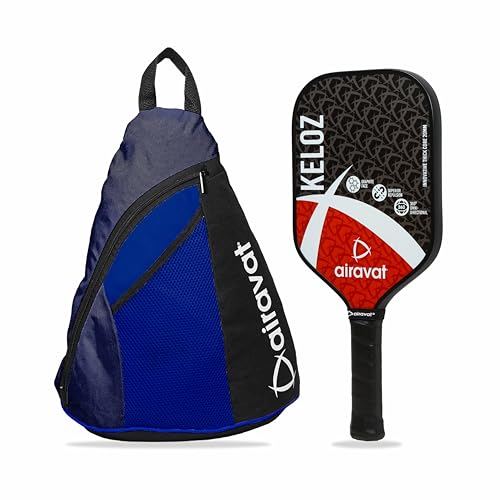
The structural foundation and the primary score driver. Rank face material: raw carbon fibre (Japanese Toray T700) > graphite > carbon/composite blend (T300) > fibreglass. Thermoformed/unibody construction with foam-injected edge walls beats cold-pressed/hot-pressed builds and resists delamination. In the ₹2,500–5,000 band, verify marketing claims against spec tables and reviews — several paddles market 'T700' while the spec sheet lists fibreglass or T300 (Pickadel), or 'carbon' with no grade (Airavat, Konex). Red flags surfaced in India reviews here: handle snapping and grips detaching (Konex — a turf-rental owner ranked it worst of all brands), logo stickers/paint sitting on the sweet spot that alter surface texture (FirstEdge VeloFlex, 2 reports). Positive durability signals: metal end cap + refined edge guard (YAIT), 1-year warranty (YAIT, Pickadel) > 6-month (PICKLX, Alphaverse) > 1-month (VOLTIK) > none (Konex, Airavat, athletiq). Do not over-credit 'thermoformed' marketing — cross-check against actual India durability sentiment.
Precision at the net and on dinks/resets. Thicker cores give a larger sweet spot and softer feel — 20mm (VOLTIK Nimbus) > 16mm > 14mm > 13mm. Raw-carbon faces and foam-injected perimeter/neck walls widen the sweet spot and forgive off-centre hits. Review signals that lift the score: 'great control', 'buttery feel', 'stable sweet spot', 'better control on dinks'; signals that lower it: 'limited sweet spot', 'spin doesn't happen', 'boardy'. Distinct from Power — a paddle can be all-control (soft 20mm) or all-power (thin 13mm); judge each on its stated intent but reward genuine sweet-spot forgiveness. Thin cores (13/14mm) trade control for pop and should not lead this criterion.
Put-away pop and spin generation. Thinner cores (13/14mm) generate more pop; raw-carbon grit and textured/friction faces generate more topspin. Review signals: 'awesome spin', 'explosive shots', 'good pop', 'aggressive drives'. A paddle can lead here while trailing on Control — that trade-off is expected (YAIT 14mm, Alphaverse 13mm lead on pop; VOLTIK Nimbus 20mm trails). Genuine raw-carbon T700 grit holds longer and spins better than generic 'carbon' or sand-painted faces; verify against reviews — Konex and Airavat reviewers explicitly report weak spin despite carbon claims.
Fit and comfort. Balanced weight 200–235g is ideal (too light = no plow-through and flimsy feel, as Konex reviewers noted at ~150g; too heavy ≥250g = arm fatigue, as with Airavat). Elongated handles ≥5.3in (COLISEO 5.5, athletiq 5.5, FirstEdge 5.6, YAIT 5.3) enable a two-handed backhand; short/standard handles limit it. Grip circumference ~4.25in fits most Indian hands (Airavat's 3in grip is notably thin). Foam/EVA-cushioned grips reduce fatigue (YAIT EVA, PICKLX cushioned). Review signals to penalise: 'grips came off' (Konex), 'slightly heavy' (Pickadel, FirstEdge), thin grip.
Price-to-spec within the ₹2,500–5,000 band, warranty, and genuine India review validation. A paddle delivering genuine raw-carbon T700 + thermoformed build at the lower end of the band with real reviews scores highest (COLISEO ₹4,599/9 reviews, athletiq ₹4,599/18 reviews, Airavat ₹2,799/12 reviews). Longer warranty adds value (YAIT 1yr). CRITICAL India-availability lesson: this band is young and thin — most India-reviewed paddles are Indian-brand SKUs with <20 reviews, so validation is limited; flag low review counts rather than rejecting. Many high-rated listings are foreign-market SKUs with 0 India reviews (Qyntelix HEX-Force had 23 US ratings, 0 from India) and must be excluded. The best-reviewed budget paddle (YAIT Xtrieve, 84 ratings) falls just below the ₹2,500 floor at ₹2,299 and is excluded on price.