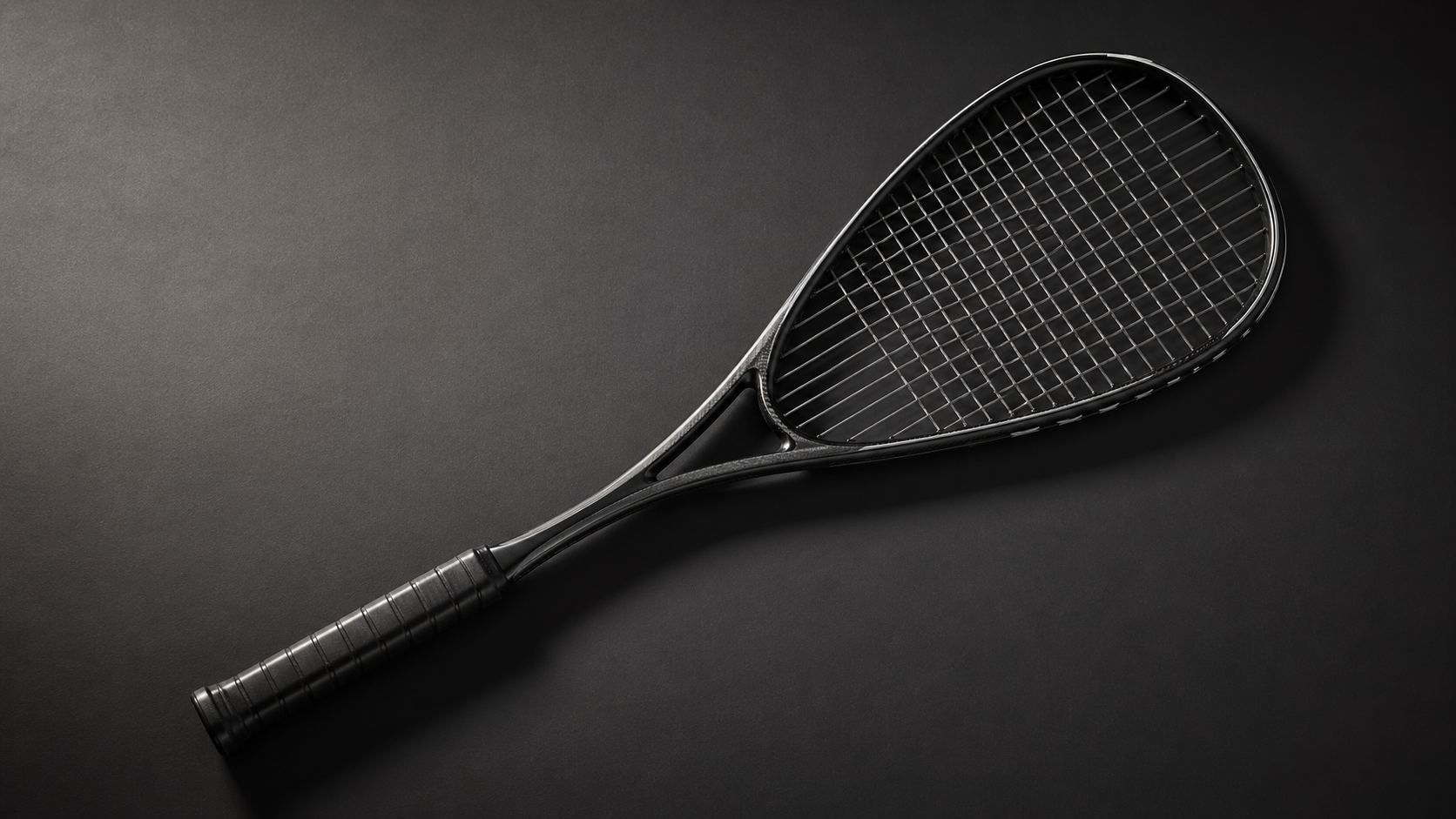
Best under ₹3,000 9.3
HEAD Nano Ti Graphite Spector 2.0
₹2,550
The only genuine full-graphite frame under ₹3,000, at 195 g with a forgiving 485 cm² head — and 4.4 stars across 981 reviews, the deepest review base in Indian squash.
The winner from each of our three price brackets — plus the two running costs nobody mentions until your first restring.

The best squash racket in India for a club player is the Tecnifibre Carboflex 125-S at ₹9,759 — a Carboflex composite frame Indian club players single out for power delivery with almost no vibration through the arm. For a first racket, the HEAD Nano Ti Graphite Spector 2.0 at ₹2,550 is the only genuine full-graphite frame under ₹3,000 and the most-reviewed squash racket on Amazon.in. For competitive play, the Dunlop SonicCore Ultimate 132 at ₹17,299.
Squash is growing quietly in Indian metros — new courts in gyms and sports complexes, more first-time players every year — but the buying experience has not caught up. Listings under ₹3,000 are cluttered with aluminium frames presented as premium options, head sizes go unstated, and stated weights range from 120 g to 360 g inside a single price band without the listings making clear why that matters.
Two costs run underneath every racket on this page, and no listing mentions either: the factory grip will peel within weeks, and the strings will break within months. Budget for both from day one and the rest of the decision gets much simpler.
The winner from each of our 3 price brackets. Every one came first in a full head-to-head roundup, not a shortlist.
₹2,550
The only genuine full-graphite frame under ₹3,000, at 195 g with a forgiving 485 cm² head — and 4.4 stars across 981 reviews, the deepest review base in Indian squash.

₹9,759
The specialist brand's club staple — Indian players consistently single out its power delivery and near-total absence of vibration over long sessions. Built for players who already have technique.

₹17,299
SonicCore Infinergy foam cuts vibration by up to 37%, and the Hybrid Cross Section pairs an oval head's power with a box shaft's control. The pick for four-sessions-a-week players.
Scores are not comparable across brackets. Each racket is scored against the others at its own price, so the 9.3 under ₹3,000 and the 9.0 under ₹20,000 are not making the same claim — the first means "outstanding for ₹2,550", the second "very good for ₹17,299". Add ₹300–₹500 for an overgrip and ₹500–₹1,500 per restring to any price here. Prices are what the Amazon.in product pages showed on 29 August 2026.
Each bracket has its own full roundup — every contender scored, specced and priced, with the ones that did not make the cut and why.
Under ₹3,000
Beginners and first rackets
Harder to shop than it looks. The listings are cluttered with aluminium frames presented as premium options, several do not state a head size at all, and weights range from 195 g to 360 g without the difference being made clear. Five of the eleven we looked at were worth recommending.
Under ₹10,000
Club players training two to three times a week
Past beginner aluminium and into proper graphite and composite construction with real technology behind it — Microgel, Intellifibers, Innegra, Carboflex. HEAD dominates the shelf; Tecnifibre is the specialist alternative worth the premium if you play often.
Under ₹20,000
Competitive amateurs and state-level players
Every frame here uses advanced graphite with proprietary engineering — SonicCore foam, Aramid reinforcement, bumperless X-Top designs. Weights cluster tightly between 120 g and 132 g, so the choice is about how the frame absorbs impact rather than how heavy it is.
Almost every squash racket sold under ₹3,000 in India draws the same complaint, across HEAD, Cosco, TANSO and Nivia alike: the factory grip peels off within days to weeks. The adhesive gives way as soon as it meets sweat, and no brand at this price is an exception.
Add ₹150–₹300 for a replacement overgrip — a Yonex Super Grap or Karakal PU Super Grip — and put it on before your first session rather than after the stock one fails. This is a known maintenance step, not a defect worth returning the racket over.
Squash is unusually hard on strings. The ball is struck at close range with full force, and the strings scrape the wall on retrievals — so factory strings typically last two to five months at two or three sessions a week, and string breakage is the single most common complaint at every price point. Some buyers of ₹9,000 rackets report breakage within days.
Restringing costs ₹500–₹1,500 depending on your city and string choice. Multifilament strings such as Tecnifibre 305 or Ashaway SuperNick last noticeably longer than the factory synthetic gut. Factor a restring or two into the real annual cost of any racket on this page.
The spread is extraordinary. Budget listings run from 195 g to 360 g, while premium frames cluster between 110 g and 132 g — meaning the cheapest racket on the shelf can be three times the weight of the most expensive one. That is not a subtle preference; a 360 g frame will visibly degrade your shot quality by the end of a 45-minute session.
For a beginner, anything under about 220 g is comfortable. Serious players generally settle between 120 g and 150 g. Very light frames below about 115 g swing fastest but feel unstable on off-centre hits, and several draw reports of cracking within months.
The comparison is unusually clean in squash because the same brand often sells both. A graphite frame weighs meaningfully less than its aluminium sibling, absorbs vibration far better, and transfers power to the back wall with less effort — and the price gap between them can be under ₹100.
Aluminium's only real advantage is that it dents rather than cracks when you hit the wall, which happens more in squash than players expect. That makes it defensible for a genuinely casual player. For anyone playing weekly, graphite is the obvious choice.
Most rackets here use a teardrop head between 470 and 500 cm². Larger heads give a bigger sweet spot and forgive off-centre hits, which matters a great deal while you are still finding the ball; slightly smaller heads trade that for control once you can. Some budget listings do not state a head size at all, which makes them impossible to compare and is reason enough to skip them.
The upgrade signal is straightforward: once you are playing three or more times a week and can consistently drive the ball to the back wall, the step up to a ₹5,000–₹10,000 frame will be noticeable in string quality, stiffness and weight distribution. Before that point it mostly will not be.
Squash is the thinnest racket market in India by some distance, and the brackets below behave differently from the other sports on this site.
Under ₹3,000 you are buying a frame that will survive you learning. Expect aluminium or a low-grade composite, a heavy 140–160 g frame, basic factory string and frequently no cover. That sounds dismissive and is not meant to be: squash beginners hit the wall constantly, and an expensive frame in a beginner's hand is a frame with a cracked head. Buying cheap first is genuinely the right strategy in squash in a way it is not in badminton.
Under ₹10,000 you are buying graphite, weight distribution and string quality. This is where frames drop to 120–140 g, the composite becomes real graphite, and the racket starts to feel like an extension of your arm rather than a tool you are wielding. For a player who has stopped hitting the wall on most shots, the difference is large and immediate.
Under ₹20,000 you are buying refinement for a committed player — ultra-light 110–125 g frames, high-modulus carbon, and a stiffness and balance that reward a fast, precise swing. The frames are also more fragile, which in a sport played inside four walls is a genuine consideration rather than a theoretical one.
The honest summary for most Indian players: buy inexpensively while you are learning, then jump straight to the ₹5,000–₹10,000 bracket when your racket stops meeting the wall. The intermediate shuffling that makes sense in badminton mostly does not here.
Squash rackets are described almost entirely by weight in Indian listings, but where that weight sits changes the racket at least as much as how much of it there is.
Head-heavy frames put mass out at the head, which gives you power on drives and a more stable racket when you are digging the ball out of a back corner under pressure. They are more tiring over a long match and slower on the quick, wristy flicks that squash demands at the front.
Head-light frames are faster in hand, which is what you want for volleying, deception and the rapid racket preparation squash rewards. The cost is less free power, so you have to generate more of it yourself.
Even-balance is the safe default and what most all-round frames aim for.
The thing worth understanding is how this interacts with weight. A 135 g head-heavy racket can feel considerably more demanding than a 145 g head-light one, because swing weight — mass multiplied by its distance from your hand — is what your arm actually experiences. This is why players who buy the lightest frame they can find sometimes find it tiring: they reduced the number on the listing and increased the number that matters.
Almost no Indian squash listing states balance. If you can hold the racket, balance it on one finger at the midpoint; where it sits tells you immediately. If you cannot, treat an unstated balance as one more reason to prefer a seller who publishes full specifications.
Squash balls carry a coloured dot that indicates bounce, and using the wrong grade is the most common reason a new player concludes squash is impossible.
Double yellow dot is the competition standard: extra slow, very low bounce, and it only comes alive once thoroughly warmed up by hard hitting. In the hands of a beginner it barely bounces at all, rallies die after one shot, and the game is genuinely unplayable.
Single yellow dot is slow with a slightly higher bounce — a reasonable step for an improving club player.
Red dot is medium speed with a noticeably higher bounce, and blue dot is fast with the highest bounce of all. Blue and red are what beginners should be using, and they make the difference between rallies that last and rallies that end immediately.
The problem in India is that double yellow is what gets sold by default, because it is the "proper" ball, and a great many new players buy it, fail to sustain a rally, and quietly stop playing. If you are starting out, buy blue or red dot deliberately and ignore anyone who tells you it is not the real thing. It is the same sport, played at a speed you can actually learn at.
Balls also have a limited life — they go shiny and lose bounce, and a ball that has been played into the wall for weeks behaves quite differently from a fresh one. They are cheap; replace them.
Squash has a small but committed following in India, concentrated in clubs, gymkhanas, and a handful of dedicated centres in Chennai, Mumbai, Delhi and Bengaluru. A few practicalities follow from that.
Court access is the real constraint, not equipment. Most Indian squash courts sit inside membership clubs, and court availability rather than gear quality is what limits how much most people play. That is worth knowing before you spend ₹15,000 on a frame you will use twice a month.
Non-marking indoor court shoes are mandatory, and most clubs enforce it because black-soled shoes leave marks on a white-walled court that are extremely difficult to remove. Beyond the rule, squash is the most lateral, most stop-start of the racket sports, and the shoe requirements are closer to badminton than tennis: gum sole, low profile, strong lateral support. Running shoes on a squash court are a genuine ankle injury waiting to happen.
Eye protection is worth taking seriously. Squash is played with two people inside an enclosed space swinging rackets, and eye injuries from the ball and from an opponent's follow-through are the sport's signature serious injury. Protective eyewear is mandatory for juniors in most organised squash worldwide and is a sensible purchase for anybody, at ₹800–₹2,000. This is the one piece of squash equipment where the case for spending is about consequences rather than performance.
Heat is a factor in Indian courts, many of which are not air-conditioned. A hot court makes the ball livelier than its dot grade suggests, and makes grips go slick faster — carry a spare overgrip.
Squash is unusually equipment-light, and the ranking of what is worth buying is fairly clear.
Court time and a regular partner come first. Squash is a skill and fitness sport played against one other person, and the limiting factor for almost every Indian club player is how often they can get on court with someone of a similar standard. Nothing you buy substitutes for that.
Shoes are second, for the injury reasons above and because confident movement is the whole game — squash is more about getting to the ball than hitting it.
Eyewear is third, on consequences alone.
Balls and a fresh grip are fourth, and they are the most under-bought items. A correct-grade ball transforms a beginner's experience, and a fresh grip on a sweaty hand in an Indian court is the difference between control and hoping.
The racket is fifth, and the case for a mid-range frame over a cheap one is real but comes later than most buyers assume. A good ₹6,000 graphite frame is enough racket for the overwhelming majority of Indian club players, permanently. The frames above it are refinements for people whose limiting factor is genuinely no longer their movement or their technique, and that is a smaller group than the marketing suggests.
Squash frames lead harder lives than any other racket, because the sport is played inside four walls and contact with them is routine rather than exceptional. Knowing what is survivable and what is terminal saves both money and a frame failing mid-rally.
Scuffed paint and a chewed bumper are cosmetic. The plastic bumper strip along the head exists precisely to be sacrificed to the wall, and on most frames it is replaceable for a few hundred rupees. A worn bumper is a maintenance item, not a reason to buy a new racket — but replace it, because once it is worn through the wall starts abrading the frame itself.
A cracked frame is terminal. Graphite cannot be repaired to a playable standard, and a crack under string tension will eventually let go. Cracks usually appear at the head where it has been driven into a wall, or at the throat. Inspect after any hard wall contact that made a crack rather than a scrape.
Broken grommets and a distorted head sit in between. Grommets are replaceable at a stringer; a head that has gone visibly out of round is not, and it will never string true again.
The practical consequence is that squash rewards a two-racket approach more than the other sports do. Many regular Indian club players keep an older frame for hard practice and a better one for matches, which is a more sensible allocation of ₹10,000 than a single expensive racket meeting a wall twice a week.
Covers are close to standard in badminton and tennis and close to absent in squash. At ₹9,000 you will usually receive a bare frame, and a cover matters more here than elsewhere because the frame is repeatedly taken into a bag alongside the wall impacts it has already absorbed. Budget ₹300–₹800 separately, and treat an included cover as a genuine point in a racket's favour.
Squash is played in a box, and scraping the frame along the side wall on a retrieval is part of the game rather than a mistake. It is also the leading cause of both string failure and frame damage. This is the one racket sport where a light aluminium frame has a real durability argument, and where a bumper strip and a protective cover pay for themselves.
The lightest frames in the premium band swing fastest and are superb at the front of the court, but the same low mass makes them feel unstable on off-centre hits and gives you less behind a drive from the back wall. Several ultralight models draw reports of cracking within two to six months. If you play a power game from the back, more mass will serve you better than a lower number on the spec sheet.
In-depth guides to help you pick the right racket and understand the specs.
We don't run paid placements and we don't accept free products. Every pick on this page comes from a roundup where we compared the full field on manufacturer specifications, independent expert reviews, and the verified buyer feedback left by Indian customers — weighting Indian evidence heavily and discounting star ratings built on buyers in other markets.