Pickleball Rules for Beginners in India
Whether you just discovered pickleball at your local club or saw it trending on social media, this guide breaks down every rule you need to know — from court dimensions and serving to the infamous kitchen rule. Written specifically for Indian players navigating the sport for the first time.
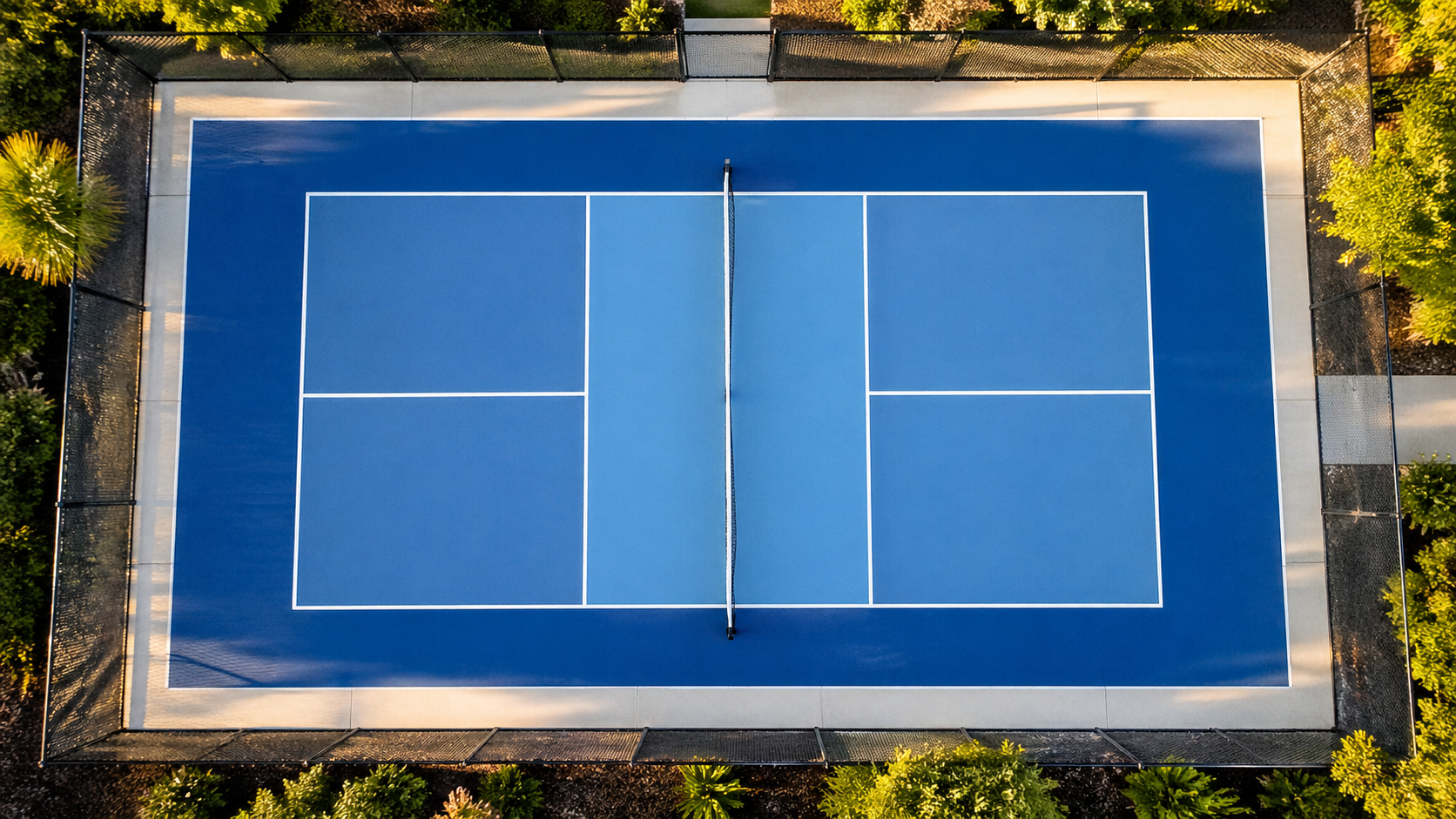
Court Dimensions & Layout
A standard pickleball court measures 20 feet wide by 44 feet long — the same footprint as a doubles badminton court. This is one of the reasons pickleball has exploded in India: existing badminton facilities can be converted with minimal effort.
| Dimension | Measurement |
|---|---|
| Court Length | 44 ft (13.41 m) |
| Court Width | 20 ft (6.10 m) |
| Non-Volley Zone (Kitchen) | 7 ft from net on each side |
| Net Height (Centre) | 34 inches (86.36 cm) |
| Net Height (Sidelines) | 36 inches (91.44 cm) |
| Service Area Depth | 15 ft (from kitchen line to baseline) |
The court is divided into two halves by the net. Each half has a non-volley zone (the kitchen) extending 7 feet from the net, and behind that, two service courts — the right (even) court and the left (odd) court — each measuring 10 feet wide by 15 feet deep.
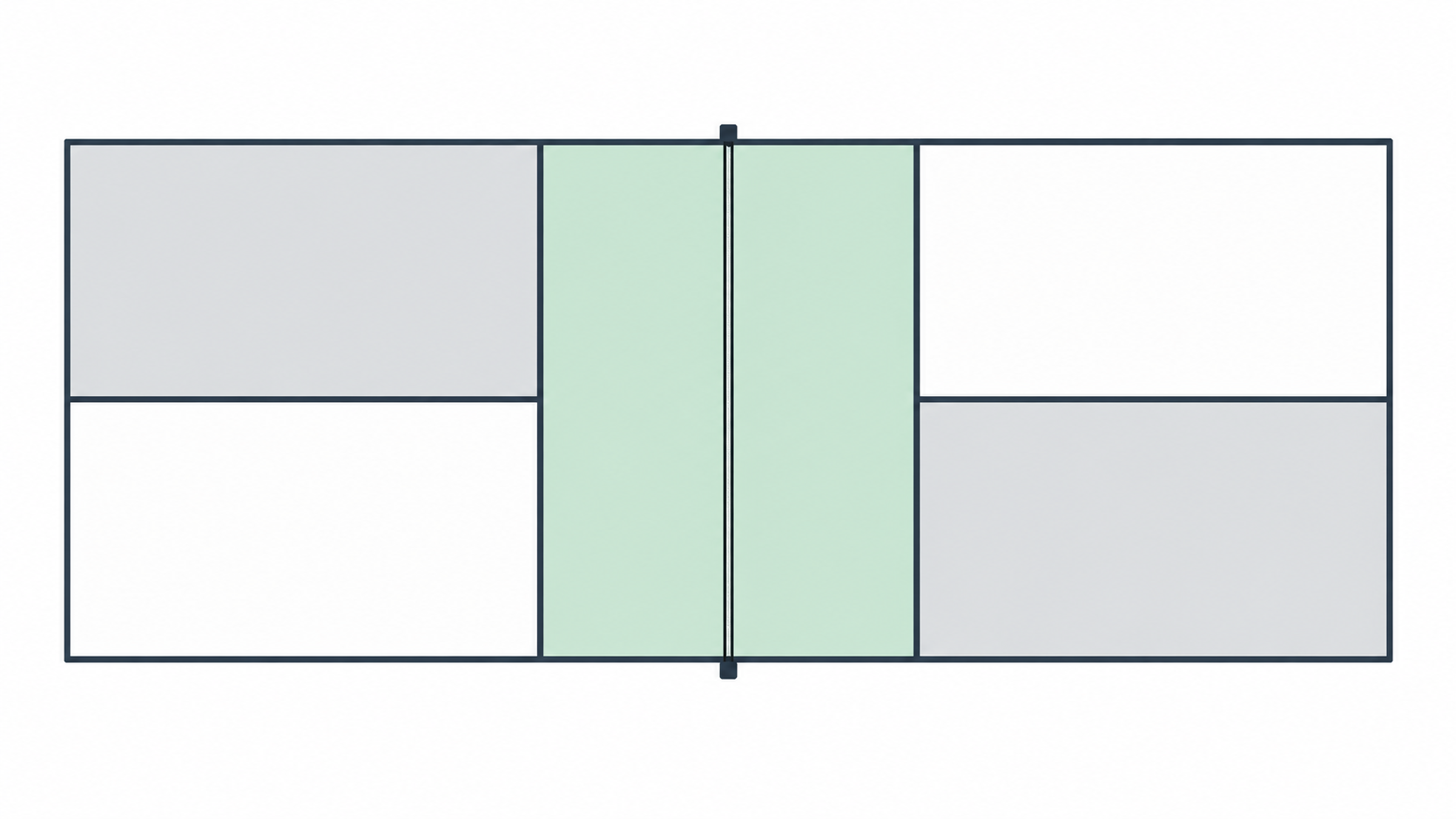
Converting a Badminton Court
If you play at a badminton facility, you already have the correct court size. Simply lower the net to 34 inches at the centre and add kitchen lines 7 feet from the net on each side using temporary tape or chalk. The badminton singles sidelines become the pickleball sidelines, and the existing baseline works perfectly. Many sports complexes in Bangalore, Mumbai, and Delhi now keep dual markings on their courts.
Serving Rules
The serve is one of the most important aspects of pickleball, and the rules around it are strict. Understanding these rules will save you from losing points on faults.
Underhand Serve Requirement
Every serve must be executed with an underhand motion. The paddle must contact the ball below your waist (navel level). Your arm must move in an upward arc. This is fundamentally different from tennis or badminton where overhead serves dominate. The underhand requirement keeps the game accessible and prevents serve-dominant play.
Drop Serve Option
Since 2022, the drop serve is a permanent rule addition. You may drop the ball from any natural height (without tossing it upward) and hit it after it bounces. When using the drop serve, the waist-level and upward-arc restrictions do not apply. This is an excellent option for beginners who find the volley serve timing difficult.
Serve Placement
- The serve must be made diagonally crosscourt — from the right service court to the opponent's right service court (your diagonal), and vice versa.
- The serve must clear the net and land in the correct service court, beyond the kitchen line.
- The server must stand behind the baseline and within the imaginary extension of the sideline and centre line.
- Only one serve attempt is allowed (no second serve like in tennis). If the serve hits the net and lands in the correct court (a let), it is replayed.
Scoring System
Pickleball scoring can be confusing for beginners, especially in doubles. There are two systems used worldwide, and you will encounter both in India depending on the format.
Side-Out Scoring (Traditional)
In traditional side-out scoring, only the serving team can score points. Games are played to 11 points, and you must win by 2. In tournament play, games may go to 15 or 21. The score in doubles is called as three numbers — for example, "4-2-1" means the serving team has 4 points, the receiving team has 2, and the current server is server number 1.
In doubles, each team gets two serves per rotation (one for each player), except at the very start of the game when the first serving team only gets one serve. This is to offset the serving advantage.
Rally Scoring
Rally scoring awards a point on every rally, regardless of who served. Games are typically played to 21 points, win by 2. This format is used in Major League Pickleball (MLP) and is gaining popularity in Indian tournaments because it shortens match times and makes broadcasts more predictable. Many recreational players in India prefer rally scoring for its simplicity.
| Feature | Side-Out Scoring | Rally Scoring |
|---|---|---|
| Who scores? | Serving team only | Either team |
| Game to | 11 (win by 2) | 21 (win by 2) |
| Score call (doubles) | Three numbers (4-2-1) | Two numbers (4-2) |
| Avg. game duration | 15-25 minutes | 10-15 minutes |
| Used in | USA Pickleball, most Indian clubs | MLP, some Indian tournaments |
Singles Scoring
Singles scoring is simpler. The score is called as two numbers (server's score first). The server serves from the right court when their score is even, and from the left court when their score is odd. There is only one serve per side-out — when you lose the rally, the serve passes to your opponent.
The Kitchen (Non-Volley Zone) Rules
The kitchen is the most unique and strategically important area on a pickleball court. It is the 7-foot zone on each side of the net, officially called the non-volley zone (NVZ). Mastering kitchen rules separates beginners from intermediate players.
Key Kitchen Rules
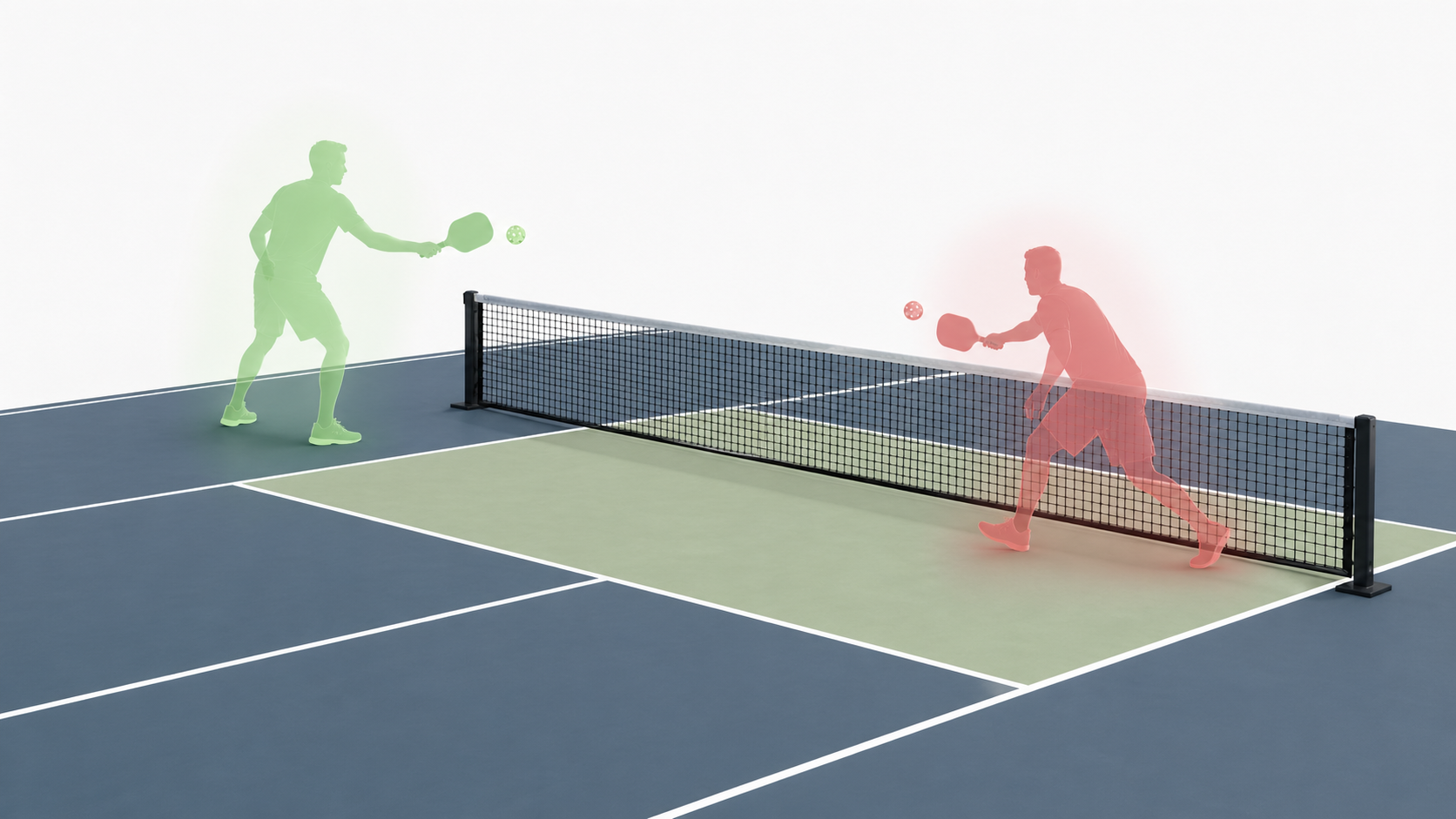
- You cannot volley (hit the ball out of the air) while standing in the kitchen or on the kitchen line.
- If your momentum carries you into the kitchen after a volley, it is a fault — even if the ball was already dead.
- You can enter the kitchen freely to play a ball that has already bounced.
- You can stand in the kitchen at any time — you just cannot volley from there.
- Anything that touches the kitchen during a volley — your paddle, hat, sunglasses, or anything that falls off your body — results in a fault.
- Your partner cannot hold you back to prevent you from entering the kitchen after a volley. You must establish balance independently.
The kitchen rule exists to prevent players from standing at the net and smashing every ball. It creates a fascinating strategic element called the kitchen line rally or "dinking game," where players exchange soft shots (dinks) just over the net, waiting for their opponent to pop the ball up for an attackable shot.
The Two-Bounce Rule
The two-bounce rule (formerly called the double-bounce rule) is fundamental to pickleball and one of the first things every beginner must internalise.
Here is how it works: after the serve, the receiving team must let the ball bounce once before returning it. Then, the serving team must also let the return bounce once before playing it. After these two bounces have occurred, both teams may either volley or play the ball off the bounce for the remainder of the rally.
This rule prevents the serving team from rushing the net immediately after serving (as in tennis). It ensures longer rallies and a more strategic game. In practice, this means: serve, let it bounce, return, let it bounce, then play freely.
Singles vs Doubles — Key Differences
Doubles is by far the more popular format in India, accounting for the vast majority of recreational and tournament play. However, singles is growing, especially among younger, more athletic players.
| Aspect | Singles | Doubles |
|---|---|---|
| Players | 1 vs 1 | 2 vs 2 |
| Court size | Full court (20x44 ft) | Full court (20x44 ft) |
| Serves per side-out | 1 | 2 (one per player) |
| Score call | Two numbers | Three numbers |
| Physical demand | High — covers entire court | Moderate — split coverage |
| Strategy emphasis | Fitness, shot placement | Communication, stacking, dinking |
| Popularity in India | Growing | Dominant format |
In doubles, positioning and communication are critical. Teams typically use a stacking strategy to keep their stronger forehand player in a preferred position. The "third shot drop" — a soft shot that lands in the opponent's kitchen — is the most important shot to develop in doubles.
In singles, athleticism matters far more. You cover the full 20-foot width alone, so footwork, conditioning, and aggressive shot placement define success. If you come from a badminton or tennis background in India, you may find singles more familiar.
Equipment Basics
Pickleball requires minimal equipment, which is a major reason it has taken off across Indian cities. Here is what you need to get started.
Paddles
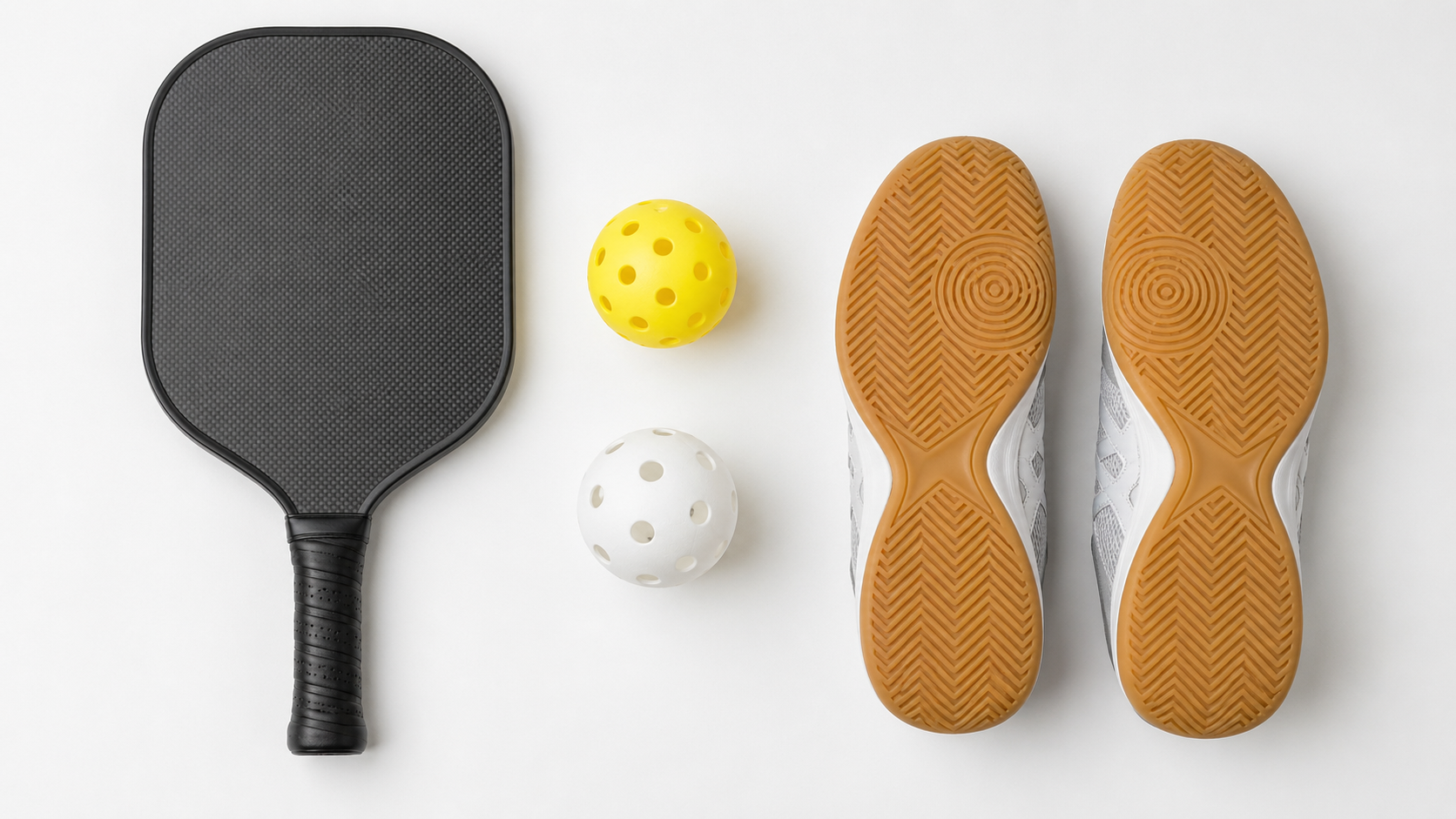
Pickleball paddles are solid (no strings) and come in various materials. Beginners should look for a paddle weighing 7.3-8.0 oz with a polymer core and graphite or fiberglass face. Budget-friendly options in India start around Rs 1,000-2,500. Check out our detailed reviews:
- Best Pickleball Paddles Under Rs 2,500
- Best Pickleball Paddles Under Rs 5,000
- Best Pickleball Paddles Under Rs 10,000
Balls
Pickleballs are perforated polymer balls, similar to wiffle balls. Outdoor balls have 40 smaller holes, are heavier, and more durable — these are the standard for most Indian play since courts are typically outdoors. Indoor balls have 26 larger holes, are lighter, and travel slower. A set of 6 outdoor balls costs Rs 500-1,000 on Amazon India.
Footwear
Wear court shoes with non-marking soles and good lateral support. Badminton shoes or volleyball shoes work well. Avoid running shoes — they lack lateral stability and increase the risk of ankle injuries during side-to-side movement.
Where to Play Pickleball in India
The Indian pickleball scene has grown exponentially since 2015. The All India Pickleball Association (AIPA), founded in 2008, organises national championships and coordinates with international bodies. Here are the key hubs:
Bangalore
India's pickleball capital with the highest number of dedicated courts. Cubbon Park, KSLTA, and multiple private academies offer regular sessions and leagues.
Mumbai
Rapidly growing scene with courts in Bandra, Andheri, and Navi Mumbai. The Mumbai Pickleball League attracts hundreds of players across skill levels.
Delhi NCR
Gurgaon and Noida lead the NCR scene with dedicated pickleball facilities in residential complexes and sports clubs. DDA complexes are adding courts.
Hyderabad & Chennai
Both cities have active communities with weekly meetups. Hyderabad hosts several state-level tournaments annually. Chennai's beach pickleball sessions are uniquely popular.
The easiest way to find courts near you is to search for local pickleball groups on Facebook or WhatsApp. Most cities have active communities that welcome beginners. Many badminton clubs and sports complexes have added pickleball time slots, so check with your nearest facility.
Common Faults to Avoid
A fault ends the rally. As a beginner, most of your faults will come from these situations:
- Serving into the kitchen: The serve must clear the kitchen and land in the correct diagonal service court.
- Volleying in the kitchen: Hitting the ball out of the air while standing in or on the kitchen line.
- Violating the two-bounce rule: Volleying the serve return or the third shot before it bounces.
- Hitting the ball out of bounds: The ball must land within the court lines (lines are in).
- Hitting the ball into the net: Self-explanatory but the most common fault at every level.
- Serving with improper form: Overhead serves, hitting above the waist, or serving from the wrong position.