Pickleball vs Badminton — Which Sport Should You Pick?
India has long been a badminton nation — from Saina Nehwal to PV Sindhu, the sport is woven into our sporting culture. But pickleball is surging. Courts are popping up in every metro city, and players of all ages are making the switch. So how do these two racket sports actually compare? This comprehensive breakdown helps you decide which one (or both) is right for you.
Quick Comparison Table
Here is a side-by-side snapshot of the key differences between pickleball and badminton. Each factor is explored in detail in the sections below.
| Factor | Pickleball | Badminton |
|---|---|---|
| Court Size (Doubles) | 20 x 44 ft | 20 x 44 ft |
| Net Height (Centre) | 34 inches (86 cm) | 5 ft (152 cm) |
| Equipment | Solid paddle + polymer ball | Stringed racket + shuttlecock |
| Ball/Shuttle Speed | 25-40 mph typical | 60-200+ mph (smash) |
| Serve Type | Underhand only | Below waist (overhead in older rules) |
| Scoring | 11 or 21 points | 21 points (best of 3 games) |
| Starter Equipment Cost | Rs 2,000-3,500 | Rs 2,000-4,000 |
| Monthly Running Cost | Rs 500-1,000 | Rs 1,500-3,000 |
| Fitness Level Required | Low-Medium | Medium-High |
| Learning Curve | Gentle — rally in minutes | Steep — weeks to rally consistently |
| Injury Risk | Low (lower impact) | Medium (shoulder, knee, ankle) |
| Olympic Status | Not yet (targeting 2032) | Yes (since 1992) |
| Courts in India | Growing rapidly (500+) | Thousands nationwide |
| Indoor/Outdoor | Both (mostly outdoor in India) | Primarily indoor |
Court & Equipment Differences
The Court
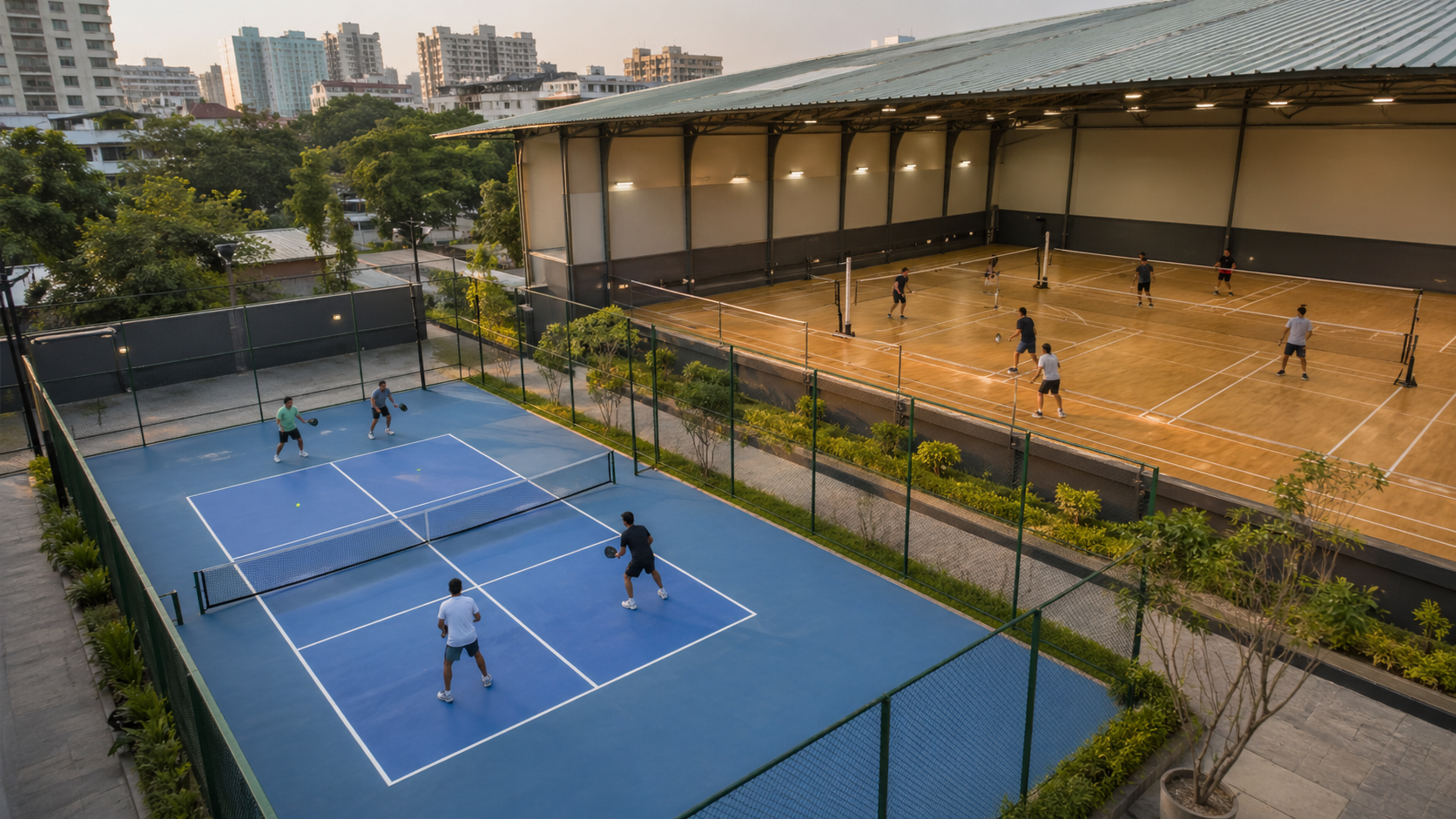
Both sports use a 20 x 44 foot court for doubles, which is why conversion between the two is so simple. The critical difference is the net: badminton nets are 5 feet (152 cm) at the centre, while pickleball nets are only 34 inches (86 cm). This lower net fundamentally changes the game — pickleball is played more horizontally, while badminton has a strong vertical element with overhead clears and steep smashes.
Pickleball has a unique non-volley zone (kitchen) extending 7 feet from the net on each side. Badminton has no equivalent restricted zone. This kitchen rule creates a distinctive strategic layer in pickleball that has no parallel in badminton.
The Equipment
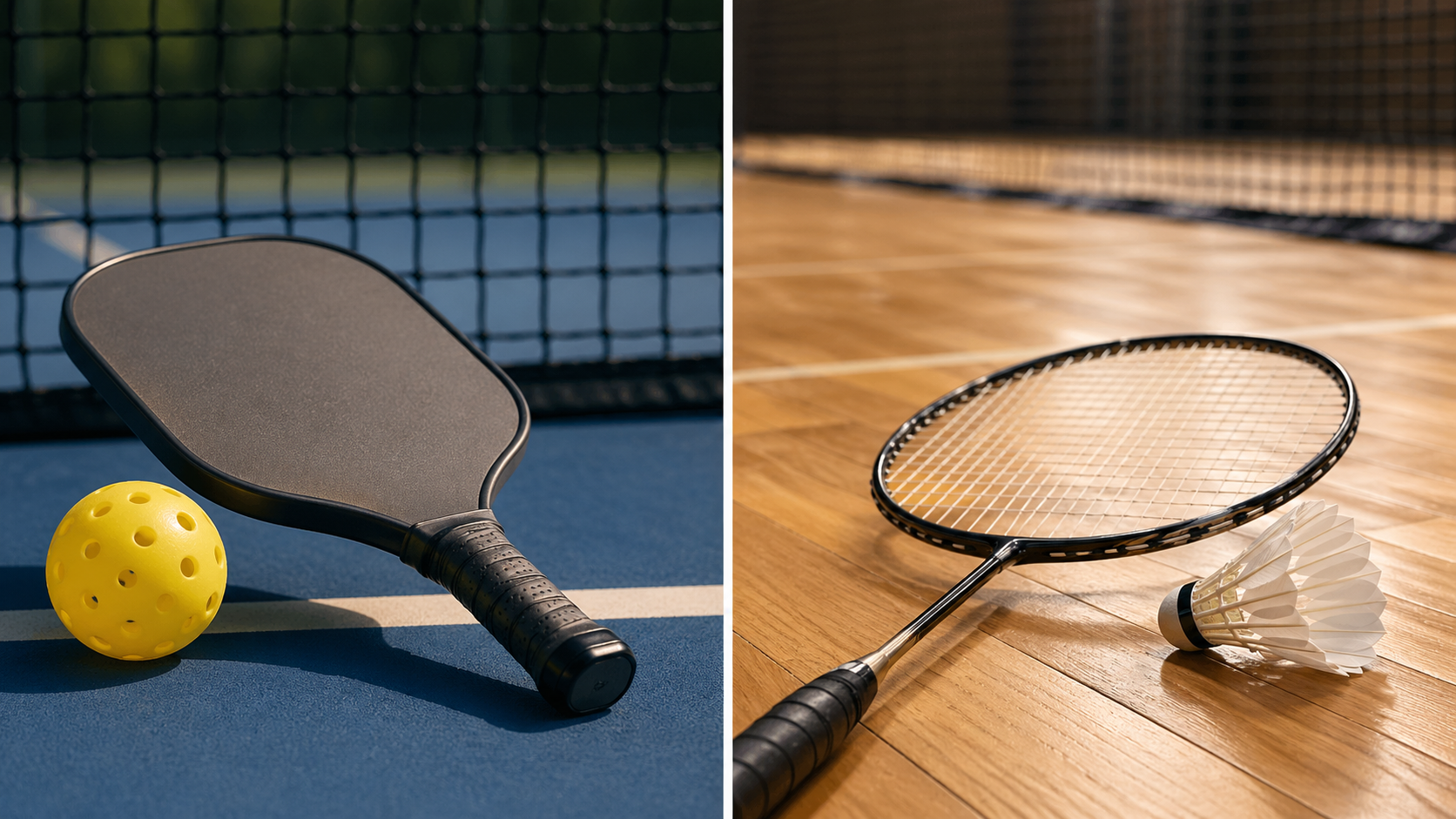
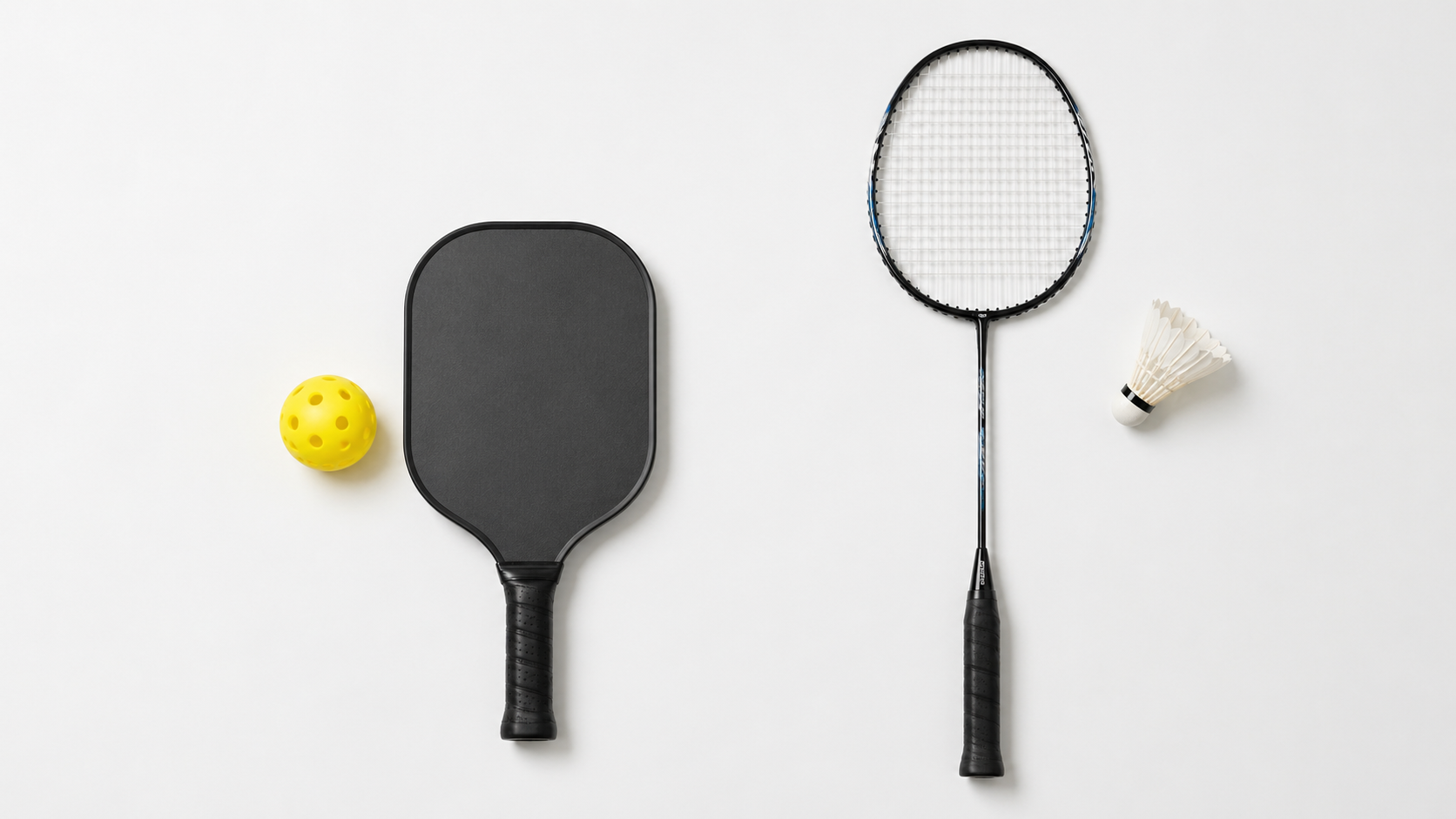
A pickleball paddle is solid — no strings, typically 15-17 inches long, weighing 200-240 g. A badminton racket is strung, about 26 inches long, and weighs 80-100 g. The difference in feel is substantial. If you are used to the flick of a badminton racket, a pickleball paddle will feel sluggish at first. You compensate with body mechanics rather than wrist snap.
The projectiles are entirely different. A pickleball is a perforated polymer ball (similar to a wiffle ball) that bounces on the court surface. A badminton shuttlecock is a feathered or synthetic cone that decelerates rapidly due to its aerodynamic drag. The shuttle does not bounce — once it hits the ground, the rally is over. This makes badminton rallies inherently more fragile and fast-paced.
Gameplay Differences
Pace & Rhythm
Badminton is a speed sport. Professional smashes exceed 400 km/h, and even club-level smashes regularly hit 200 km/h. Rallies alternate between slow, floating clears and explosive, fast-twitch smashes. The game rewards reflexes and explosive movement.
Pickleball is a strategy sport. Ball speeds rarely exceed 60 km/h in recreational play. Rallies are built around patience, placement, and the "soft game" — gentle dinks over the net that probe for openings. The game rewards anticipation, court positioning, and touch. Hard drives and smashes exist in pickleball, but the kitchen rule means brute force alone does not win games.
Serving
In pickleball, the serve is underhand only and must clear the non-volley zone. It is primarily a way to start the rally, not a weapon. In badminton, serves can be short, flick, or driven, and at advanced levels, the serve is a tactical weapon that sets up the third shot.
Rally Structure
A typical pickleball doubles rally follows this pattern: serve, return (both must bounce), then both teams work to reach the kitchen line and engage in a dinking battle. The point is won when someone pops the ball up too high, allowing the opponent to attack.
A typical badminton rally involves a mix of clears (deep shots to the baseline), drops (soft shots near the net), drives (flat, fast shots), and smashes (steep downward attacks). Movement covers the full court in all directions — forward, backward, and laterally.
Fitness & Physical Demands
This is one of the most important considerations for Indian players, especially those choosing a sport for long-term recreational fitness.
| Physical Aspect | Pickleball | Badminton |
|---|---|---|
| Calories/Hour (Doubles) | 250-350 | 350-500 |
| Calories/Hour (Singles) | 400-500 | 400-550 |
| Court Coverage | Moderate — less ground to cover | High — full court movement |
| Jumping Required | Minimal | Frequent (smashes, clears) |
| Shoulder Stress | Low (underhand strokes) | High (overhead strokes) |
| Knee Impact | Low-Medium | Medium-High |
| Playable Age Range | 8-80+ | 10-65 |
| Common Injuries | Elbow strain, ankle sprains | Shoulder injury, knee, Achilles |
Badminton is the more physically demanding sport, especially in singles. It requires explosive footwork, jumping ability, overhead power, and sustained cardiovascular endurance. The rapid deceleration and direction changes put significant stress on knees and ankles.
Pickleball is gentler on the body. The smaller effective playing area (since you do not run to the back court), absence of overhead strokes, and slower ball speed make it accessible to a wider age range. In India, this is a major reason pickleball has attracted many 40+ and 50+ players who found badminton too taxing on their joints.
That said, competitive pickleball singles is no joke. The lateral movement, quick reflexes at the kitchen line, and sustained rallying provide an excellent cardio workout. Do not assume pickleball is "easy" because it is lower impact.
Cost Comparison in India (INR)
Let us break down the actual costs of playing each sport in India, from initial equipment to ongoing expenses.
Initial Equipment Cost
| Item | Pickleball | Badminton |
|---|---|---|
| Racket / Paddle (Beginner) | Rs 1,500-2,500 | Rs 1,500-3,000 |
| Balls / Shuttles | Rs 500-800 (6 balls) | Rs 800-1,500 (1 tube feather) |
| Court Shoes | Rs 2,000-4,000 | Rs 2,000-5,000 |
| Bag | Rs 500-1,500 | Rs 800-2,000 |
| Total Starter Kit | Rs 4,500-8,800 | Rs 5,100-11,500 |
Monthly Running Costs (Playing 3x per Week)
| Expense | Pickleball | Badminton |
|---|---|---|
| Court Rental (shared) | Rs 300-800/month | Rs 500-2,000/month |
| Consumables | Rs 100-200 (balls last months) | Rs 800-2,000 (shuttles) |
| Restringing | N/A (solid paddle) | Rs 300-800 (every 2-3 months) |
| Grip Replacement | Rs 100-200 | Rs 100-200 |
| Monthly Total | Rs 500-1,200 | Rs 1,700-5,000 |
The biggest ongoing cost difference is consumables. Feather shuttlecocks are expensive and fragile — a tube of Yonex Mavis 350 nylon shuttles costs Rs 800-1,000 and lasts a few sessions, while feather shuttles (Li-Ning A+60 or Yonex AS-30) cost Rs 1,200-2,000 per tube and last even less. Pickleballs, by contrast, are durable and a set of 6 can last several months of regular play.
For paddle and racket recommendations at every budget, see our detailed reviews:
Availability in India
Badminton Infrastructure
Badminton has decades of infrastructure in India. Every city has multiple indoor courts, coaching academies are established from grassroots to elite level, and the Badminton Association of India (BAI) is a well-funded federation. You can find a badminton court within a few kilometres in virtually any Indian city or large town. Equipment is widely available from brands like Yonex, Li-Ning, Victor, and Cosco at every price point.
Pickleball Infrastructure
Pickleball infrastructure in India is growing explosively but still young. As of 2026, dedicated pickleball courts exist in Bangalore, Mumbai, Delhi NCR, Hyderabad, Chennai, Pune, and Kolkata. Many more cities have converted badminton or tennis courts for dual use. The All India Pickleball Association (AIPA) organises national tournaments, and state-level associations are active in 20+ states.
Finding a place to play pickleball is easiest in Tier-1 cities. In Tier-2 and Tier-3 cities, you may need to set up your own net on a flat surface or convert a badminton court. The good news: portable pickleball nets are available on Amazon India for Rs 3,000-6,000, and you can draw temporary court lines with chalk or tape.
Learning Curve
This is where the two sports diverge most dramatically.
Pickleball: Minutes to Rally, Months to Master
Pickleball is famously easy to pick up. The underhand serve is intuitive, the ball travels slowly enough to track, and the paddle's solid surface means you make contact on almost every swing. A complete beginner can sustain rallies within 15-30 minutes of picking up a paddle. Within a few sessions, you will understand positioning and basic strategy.
However, reaching an intermediate level takes real effort. The soft game (dinking), third shot drops, strategic lobbing, and point construction require months of deliberate practice. The gap between a 3.0 and 5.0 player (on the standard rating scale) is enormous.
Badminton: Weeks to Rally, Years to Master
Badminton has a steeper initial learning curve. The shuttlecock's aerodynamics are unintuitive — it decelerates rapidly and requires precise timing to hit cleanly. Overhead strokes (clears, smashes, drops) require significant technique to execute consistently. Most beginners need several weeks of regular practice before they can sustain rallies reliably.
The skill ceiling in badminton is also very high. Proper footwork patterns, advanced deception (slicing, holding shots), and tactical awareness take years to develop. This depth is part of badminton's appeal — there is always something new to learn.
| Milestone | Pickleball | Badminton |
|---|---|---|
| First Rally | 15-30 minutes | 1-3 sessions |
| Comfortable in Games | 2-4 weeks | 1-3 months |
| Intermediate Level | 3-6 months | 6-18 months |
| Advanced / Tournament | 1-2 years | 2-5 years |
Which Sport Suits Your Personality?
Your ideal sport depends on what you value most. Here is a guide based on personality and preferences.
Choose Pickleball If You...
- + Want a sport you can enjoy from day one
- + Are over 40 or have joint concerns
- + Enjoy strategic, chess-like gameplay
- + Want to play with family across age groups
- + Prefer a social, community-driven sport
- + Want lower ongoing equipment costs
- + Like being part of a growing, new movement
Choose Badminton If You...
- + Want an intense cardiovascular workout
- + Enjoy speed, power, and explosive movement
- + Have Olympic or professional aspirations
- + Want established coaching infrastructure
- + Prefer a sport with deep technical mastery
- + Need easy access to courts anywhere in India
- + Want to follow Indian players on the world stage
Can You Play Both?
Absolutely — and many Indian players do. In fact, playing both sports can make you better at each one. Here is why:
- Badminton improves your pickleball by developing net awareness, hand-eye coordination, footwork, and the ability to read your opponent's body language. Badminton players typically have excellent reflexes that translate directly to the kitchen line.
- Pickleball improves your badminton by sharpening your soft game, patience, and strategic shot placement. The dinking game develops touch that translates to better net shots in badminton.
- Cross-training benefits: Alternating between sports reduces repetitive strain injuries by varying the movement patterns and muscle groups used. Badminton emphasises overhead motion; pickleball emphasises lateral and low movement.
The main adjustment when switching between sports is the serve mechanic (overhead vs underhand) and the weight of equipment. Give yourself a few minutes of warm-up to recalibrate your timing when switching sports.
Many clubs in Bangalore, Mumbai, and Delhi now offer both badminton and pickleball sessions on the same courts at different time slots. This makes it practical to play both in the same facility, often on the same day.
Our Take
If you are under 35 and athletic, try both and see which resonates. If you are over 40 or want a sport the whole family can play together, start with pickleball — you will be playing rallies on your very first day. If intense physical competition is what drives you, badminton's speed and power are hard to beat.